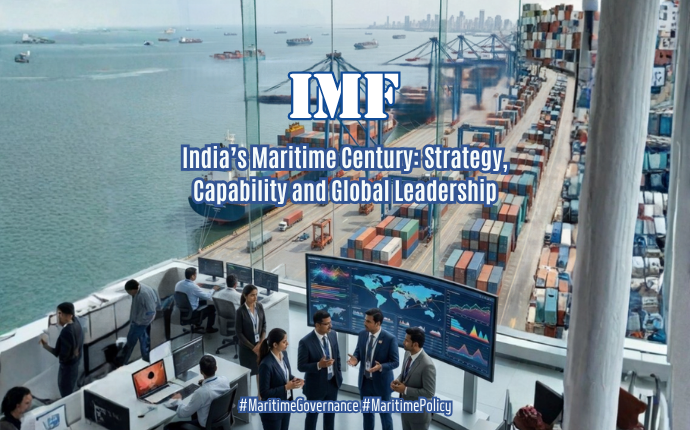
Maritime systems have always shaped the trajectory of economic and geopolitical development. Across history, the nations that engaged deeply with the sea — not merely as a route of exchange but as a domain of structured capability — were those that sustained long-term participation in global commerce, influence and institutional formation. Maritime engagement has never been limited to ships or trade alone. It has involved governance, human capital, infrastructure, finance and strategic orientation operating together as an integrated national framework.
The concept of a maritime century is therefore not defined simply by increased shipping activity or expanded port capacity. It describes a period in which maritime systems become central to a nation’s long-term economic resilience, institutional maturity and global engagement. For India, whose geographic position, economic trajectory and workforce participation increasingly converge around maritime activity, the prospect of such a century represents a structural transformation in how national development aligns with global maritime systems.
India’s maritime presence is already extensive. Its trade flows rely heavily on ocean transport. Its seafarers serve across international fleets. Its ports form vital nodes within regional and global logistics networks. Its regulatory and institutional frameworks continue to evolve in alignment with international standards. These elements together reflect an expanding maritime footprint. Yet the defining feature of a maritime century is not the scale of presence alone. It is the coherence of strategy through which presence is sustained and extended across time.
Strategy, in this context, refers to the alignment of national capabilities with long-term maritime objectives. It involves recognising maritime systems not as isolated sectors but as interconnected components of economic structure, workforce development, institutional governance and global participation. Strategic orientation ensures that investments in infrastructure, training, financial architecture and regulatory frameworks function as mutually reinforcing elements of a unified maritime vision.
Capability forms the operational expression of this strategic alignment. It encompasses physical infrastructure, fleet capacity, professional expertise, administrative depth and financial resilience. Capability is not static. It evolves through sustained investment and institutional learning. A maritime century requires that capability expands proportionately with the scale and complexity of maritime engagement. It also requires that capability remains adaptable to technological transformation, environmental responsibility and shifting global trade dynamics.
Global leadership represents the outward dimension of this integrated development. Leadership does not arise from scale alone. It emerges from the capacity to contribute meaningfully to the evolution of maritime systems beyond national boundaries. Nations that demonstrate reliable governance, sustained professional capability and institutional coherence acquire influence within global maritime discourse. Their experience informs collective decision-making. Their participation shapes shared standards.
India’s maritime evolution increasingly reflects the interaction of these three dimensions. Economic expansion continues to deepen the country’s reliance on maritime trade. Institutional frameworks are strengthening to manage growing operational complexity. Workforce participation extends India’s presence across global shipping systems. Infrastructure development enhances logistical integration. Financial and regulatory structures continue to adapt to emerging realities. Together, these developments indicate movement toward a more integrated maritime identity.
The foundation of such integration lies in institutional coherence. Maritime systems do not function effectively when infrastructure, workforce, governance and finance evolve independently. Their interaction determines whether expansion produces stability or fragmentation. Strategic alignment ensures that development across these domains reinforces overall maritime capacity rather than generating isolated growth.
India’s maritime governance environment increasingly reflects this integrative orientation. Alignment with international conventions, development of regulatory frameworks and expansion of administrative capacity support structured participation in global maritime systems. Institutional maturity enables the country to engage internationally not only as a participant but as a contributor to the evolution of maritime governance.
The Indian Maritime Federation’s engagement across policy dialogue, industry participation and workforce development reflects recognition that long-term maritime strength depends on systemic coherence. Observations across the maritime ecosystem indicate that strategic alignment among institutional domains enhances resilience, supports sustained investment and strengthens global engagement. Dialogue that reinforces such alignment contributes to the gradual consolidation of maritime capability.
Technological transformation will play a decisive role in shaping the trajectory of India’s maritime century. Advances in digital navigation, environmental compliance and logistics integration are redefining the operational landscape of global shipping. Nations that integrate technological innovation into coherent governance frameworks enhance both efficiency and credibility. Capability must therefore include not only physical infrastructure but adaptive institutional systems capable of incorporating technological change.
Environmental responsibility represents another defining dimension of contemporary maritime development. The transition toward sustainable shipping practices requires coordinated adjustment across regulatory, financial and operational domains. Strategic alignment ensures that environmental objectives integrate into broader maritime capability rather than functioning as separate compliance obligations. Leadership emerges where such integration contributes constructively to global sustainability frameworks.
Human capital remains central to the continuity of maritime strength. The knowledge, skill and experience of maritime professionals sustain operational reliability across global shipping networks. Workforce development that remains aligned with evolving technological and regulatory environments ensures that professional capability continues to support both national participation and global contribution.
Financial architecture provides the economic foundation through which maritime capability expands and adapts. Investment in infrastructure, fleet modernisation and technological transformation depends on financial systems capable of sustaining long-term commitments. Coherent financial structures enable strategic development to proceed with continuity rather than episodic adjustment.
Administrative depth ensures that these multiple dimensions remain coordinated as maritime systems grow in complexity. Governance frameworks must manage expanding interaction across domestic and international domains. Institutional capacity must sustain continuity across long-term development cycles. Administrative systems provide the structural stability within which strategy and capability operate effectively.
Global leadership emerges from the cumulative performance of these interconnected elements. Nations that sustain coherent maritime systems over time contribute not only to their own development but to the evolution of global maritime practice. Their institutional experience informs shared standards. Their operational capability supports collective stability. Their participation strengthens the governance frameworks that structure global shipping.
India’s maritime century, therefore, is not a projection of future dominance but an unfolding process of structured integration. It reflects the gradual alignment of strategy, capability and institutional maturity with the evolving architecture of global maritime systems. Leadership emerges where national development contributes constructively to the shared enterprise of maritime governance and exchange.
The temporal horizon of such transformation extends across decades. Maritime systems evolve gradually through accumulation of capacity and experience. Investments in infrastructure, workforce development and institutional frameworks yield effects that persist across generations. A maritime century is not inaugurated at a single moment. It is realised through sustained continuity of strategic development.
India’s geographic position, economic momentum and workforce participation provide the structural conditions through which such continuity can unfold. The challenge and opportunity lie in maintaining coherence across the diverse domains that constitute maritime capability. Where alignment remains strong, development proceeds with stability. Where capability continues to deepen, participation expands with confidence. Where global engagement remains constructive, leadership gradually emerges.
Maritime history demonstrates that nations whose maritime systems endure are those that treat the sea not merely as a channel of movement but as a domain of organised capability supported by coherent institutions. India’s ongoing maritime development reflects movement toward precisely such organisation.
In the long arc of global maritime evolution, a nation’s maritime century is defined by the sustained integration of its economic life, institutional capacity and global engagement within the structures of maritime exchange. For India, the foundations of such integration are increasingly visible. Strategy provides direction. Capability provides substance. Leadership emerges through participation that is consistent, credible and aligned with the shared future of global maritime systems.