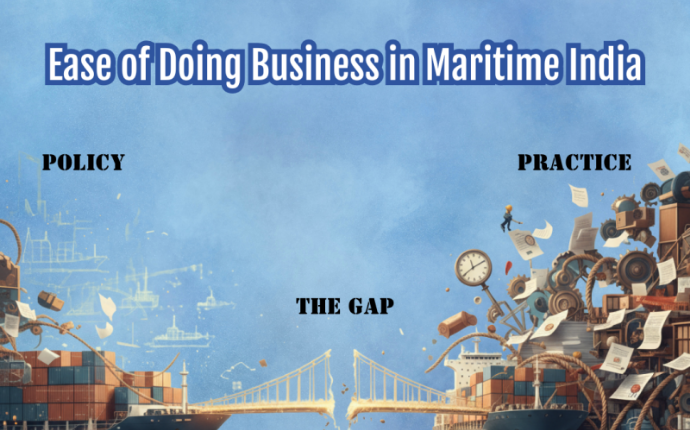
Every expanding economic sector carries within it a dual narrative. One unfolds in the realm of policy, where vision is articulated, direction is established and frameworks are constructed to guide development. The other unfolds in the lived experience of those who operate within that framework, where intention is translated into process, and process into everyday action. When these two narratives remain closely aligned, growth acquires momentum that feels natural and sustainable. When they begin to diverge, even subtly, friction emerges—not as open disruption, but as a gradual accumulation of complexity that shapes how systems actually function.
India’s maritime sector has, over the past decades, witnessed a steady strengthening of policy intent aimed at expanding capacity, improving global competitiveness and supporting industry development. The language of ease of doing business has increasingly found expression in strategic planning and institutional discourse. The objective is clear and widely shared: to create an environment in which maritime enterprises can operate efficiently, responsibly and with confidence in the stability of regulatory expectations. Such clarity of direction reflects an understanding that economic vitality and institutional credibility are deeply interconnected. Where the operating environment is predictable and proportionate, investment becomes more secure, operational planning becomes more reliable and long-term sectoral growth becomes more achievable.
Yet as maritime activity expands in scale and complexity, the translation of policy intent into operational experience becomes a more intricate undertaking. Ease of doing business is not a condition that arises solely from the presence of supportive policy. It emerges from the cumulative interaction of procedures, timelines, compliance mechanisms and administrative interfaces that shape how enterprises move through the system. These interactions are often invisible when viewed from a distance, but they define the rhythm of everyday operations. It is here, within the practical mechanics of implementation, that the relationship between intention and experience becomes most visible.
India’s maritime operators function within an environment that has evolved through successive layers of regulatory refinement. Each layer has been introduced to address specific requirements—safety standards, financial responsibility, certification integrity, welfare assurance and international compliance obligations. The purpose of these layers is protective, and their presence reflects the sector’s commitment to credibility and accountability. Over time, however, layered systems require continuous calibration to ensure that their cumulative effect remains proportionate to the activity they govern. Without such calibration, even well-intentioned safeguards can begin to interact in ways that introduce procedural density beyond what was originally envisaged.
For many enterprises, particularly those navigating international commercial cycles, operational planning depends not only on the clarity of regulation but also on the predictability of administrative flow. Decisions regarding deployment, investment, staffing and compliance scheduling are shaped by expectations about how processes will unfold over time. When these expectations remain consistent, planning horizons remain stable. When processes become more variable or extended, even modestly, planning becomes more cautious. This does not reflect resistance to regulation. It reflects the natural response of any operational system to uncertainty in the timing and sequencing of required actions.
The experience of procedural density rarely manifests as overt difficulty. It is more often experienced as gradual elongation of processes that once felt straightforward. Documentation may require multiple points of verification. Coordination across administrative units may demand additional time. Financial commitments may remain tied to compliance instruments that restrict liquidity longer than operational conditions would otherwise require. Each of these developments is understandable within its own context. Taken together, they form an operational environment in which the practical effort required to navigate routine obligations steadily increases.
Such developments are not unusual in sectors that undergo sustained expansion. As activity multiplies, governance mechanisms must adapt to ensure continued oversight. The challenge lies not in the existence of regulation but in maintaining a balance between protection and operational fluidity. Where regulatory systems evolve incrementally in response to emerging requirements, the cumulative architecture can become more complex than any single design decision would have produced. Over time, this complexity can begin to influence how policy objectives are experienced at ground level, even when those objectives remain clearly defined at the institutional level.
For India’s maritime ecosystem, the relationship between policy commitment and operational experience carries particular significance because of the sector’s strategic role in national economic development. Shipping enterprises operate within competitive international markets where cost structures, responsiveness and predictability influence commercial viability. The environment within which they function shapes their ability to adapt to fluctuating trade conditions, invest in modernisation and maintain financial resilience. When administrative processes require sustained attention beyond what operational scale alone would demand, enterprises must allocate resources not only to productive activity but also to navigating procedural pathways that support compliance.
This dynamic does not suggest misalignment between policy and practice in principle. Rather, it reflects the inherent complexity of translating broad institutional objectives into detailed operational frameworks across a sector that spans multiple jurisdictions, regulatory domains and economic pressures. Ease of doing business, in such an environment, is not a static achievement but an ongoing process of alignment. It requires continuous attention to how procedures function in real conditions, how administrative capacity scales with activity and how regulatory safeguards interact with financial and operational realities.
The experience of smaller and mid-scale enterprises offers particular insight into how this alignment evolves. Larger organisations often possess internal administrative capacity that allows them to absorb procedural complexity with relative ease. For smaller operators, the same requirements may represent a proportionally greater allocation of time, capital and organisational attention. The objective of regulatory parity ensures that standards remain consistent across the sector. Yet the operational experience of meeting those standards can vary depending on organisational scale, resource availability and market exposure. Recognising this variation is an important step in understanding how ease of doing business is experienced across different segments of the maritime economy.
Globally, maritime sectors that have navigated similar phases of expansion have often responded by refining not the intent of regulation but the design of its implementation pathways. They have sought to reduce procedural repetition, integrate verification processes and align administrative timelines more closely with operational cycles. These refinements do not weaken oversight. They enhance its sustainability by ensuring that governance mechanisms remain proportionate to the activity they supervise. In doing so, they preserve both the integrity of standards and the fluidity of operations.
India’s maritime policy landscape already reflects an awareness that economic growth and regulatory clarity must advance together. The continued articulation of ease of doing business as a guiding objective signals recognition that administrative efficiency is itself a form of infrastructure. Just as ports, vessels and logistics networks support commercial activity physically, regulatory systems support it institutionally. When that institutional infrastructure functions predictably and proportionately, it strengthens confidence across the sector. When it becomes more demanding to navigate, even subtly, it shapes how enterprises allocate their attention and resources.
The Indian Maritime Federation observes this evolving relationship between policy and practice with a focus on continuity rather than contrast. The commitment to improving the business environment remains firmly embedded within national maritime strategy. The question that naturally follows is how implementation pathways can continue to evolve so that operational experience reflects the clarity of institutional intent. Engagement across the sector reveals a shared understanding that governance must remain responsive not only to the need for oversight but also to the need for proportionate administrative flow.
Such responsiveness is not achieved through abrupt adjustment but through gradual refinement informed by observation, dialogue and practical experience. It involves examining how procedures interact in sequence, how compliance mechanisms influence financial flexibility and how administrative capacity aligns with the volume of activity it supports. The objective is not simplification for its own sake but coherence—ensuring that the collective structure through which regulation operates remains as navigable as the policies that define it.
India’s maritime sector stands within a moment of sustained expansion and institutional maturation. The continued alignment of policy aspiration with operational experience will play an important role in shaping how that expansion unfolds. Ease of doing business, understood in its fullest sense, is not merely the reduction of procedural burden. It is the creation of an environment in which regulatory integrity and operational efficiency reinforce one another naturally. Achieving this alignment requires attention not only to what policy intends but to how systems function in practice.
As maritime activity continues to grow in scale and reach, the dialogue between institutional vision and operational reality will remain an essential part of sectoral development. The structures that support enterprise must evolve alongside the ambitions that guide it. Where policy and practice move in harmony, growth acquires a steadiness that reflects both confidence and continuity. Within that harmony lies the foundation of an environment in which maritime enterprise can flourish while regulatory purpose remains fully realised.