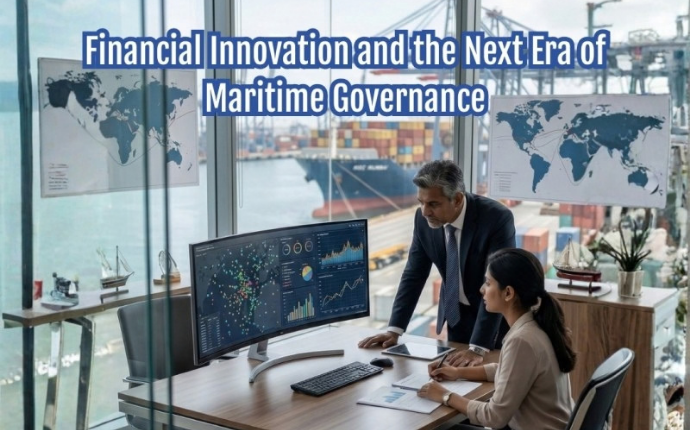
Maritime systems have always evolved through the interaction of physical movement, institutional regulation and financial structure. Ships carry goods, governance establishes rules and finance sustains the economic viability of operations across extended time horizons. These three dimensions are inseparable. When one changes, the others adjust in response. In the contemporary maritime environment, the pace and scale of transformation within global shipping are increasingly shaped by developments in financial architecture. Financial innovation is not simply supporting maritime activity. It is becoming a central force influencing how maritime governance itself evolves.
Innovation in maritime finance does not arise solely from the search for efficiency or profitability. It emerges from structural shifts in the scale, complexity and risk profile of maritime activity. As shipping networks expand, environmental standards tighten, technological systems become more sophisticated and workforce participation becomes more globally distributed, the financial mechanisms that sustain maritime operations must adapt correspondingly. Traditional financial arrangements, designed for earlier operational conditions, may continue to function but may no longer align proportionately with emerging realities. Innovation becomes a process through which financial structures adjust to maintain coherence between risk, responsibility and operational continuity.
Maritime governance responds to this adjustment because financial mechanisms influence how regulatory obligations are implemented, how compliance is sustained and how institutional accountability is structured across the sector. Financial arrangements determine how risk is distributed, how capital is mobilised and how long-term commitments are supported. When these arrangements evolve, governance frameworks must adapt to ensure that regulatory objectives remain achievable within the new financial landscape.
India’s maritime sector is increasingly situated within this global context of financial transformation. Expansion of domestic shipping capacity, integration into international trade networks and the growing complexity of maritime regulation all interact with financial structures that support investment, compliance and operational continuity. As the scale and diversity of maritime activity increase, the relationship between financial design and governance effectiveness becomes more pronounced.
Financial innovation, in this environment, can be understood as the development of mechanisms that reorganise how capital, risk and responsibility are structured across the maritime ecosystem. These mechanisms may include new approaches to risk pooling, alternative models of financial assurance, structured investment frameworks or adaptive financing instruments aligned with evolving regulatory requirements. Each innovation reflects an effort to align financial capacity with the changing contours of maritime activity.
Governance must respond to these developments not by resisting change but by integrating it into coherent regulatory frameworks. Financial innovation introduces new forms of institutional interaction. It alters how obligations are met, how compliance is verified and how accountability is maintained. Governance systems that remain attentive to these shifts are able to preserve regulatory clarity while enabling financial structures that support operational sustainability.
Globally, maritime systems that demonstrate high levels of institutional adaptability often integrate financial innovation into governance through structured dialogue among regulatory bodies, industry participants and financial institutions. This dialogue ensures that emerging financial mechanisms remain aligned with the broader objectives of safety, environmental responsibility and workforce protection. Innovation becomes an extension of governance rather than an external force acting upon it.
India’s maritime environment increasingly reflects the importance of such alignment. Financial frameworks that support shipping operations must correspond to domestic regulatory requirements and international standards simultaneously. Investment in fleet modernisation, environmental compliance and technological adaptation all depend on financing structures capable of sustaining long-term commitments. Governance, in turn, must remain responsive to the evolving forms of financial participation that support these commitments.
The Indian Maritime Federation’s engagement across industry and policy domains reflects recognition that financial architecture is not separate from governance but interwoven with it. Observations across the maritime ecosystem indicate that systems function most effectively when financial mechanisms support regulatory objectives while preserving operational viability. Dialogue that fosters coherence between financial design and governance frameworks contributes to the gradual evolution of maritime regulation itself.
Financial innovation also influences the distribution of participation within maritime economies. Traditional financing structures may favour certain forms of enterprise or operational scale. Emerging financial mechanisms have the potential to broaden access to capital, diversify participation and support new forms of maritime activity. Governance must therefore consider how financial evolution shapes the structure of the sector as a whole.
Technological transformation provides a clear illustration of this dynamic. Advances in digital navigation systems, automation and environmental performance technologies often require significant capital investment. Financial innovation creates pathways through which such investment becomes feasible across varying operational contexts. Governance frameworks that recognise and integrate these pathways enable technological adoption without undermining regulatory integrity.
Environmental responsibility presents another domain in which financial innovation intersects with governance. The transition toward sustainable maritime operations involves complex financial commitments related to energy systems, emissions reduction and infrastructure adaptation. Financial instruments designed to support these transitions influence how regulatory standards are implemented in practice. Governance evolves as financial mechanisms provide structured means through which compliance becomes economically viable.
The temporal dimension of maritime finance further reinforces its role in shaping governance. Shipping assets operate across long lifecycles. Infrastructure investments extend across decades. Workforce development unfolds over entire professional careers. Financial mechanisms must therefore support obligations that persist across extended time horizons. Governance frameworks that integrate long-term financial structures maintain continuity while accommodating gradual transformation.
International maritime systems provide numerous examples of how financial innovation contributes to regulatory evolution. Risk-sharing arrangements, specialised insurance structures and adaptive financing models have historically influenced how maritime governance addresses emerging challenges. These developments illustrate that financial architecture is not merely an operational tool but a component of institutional design.
India’s maritime future will increasingly involve engagement with such evolving financial environments. As the sector expands and integrates more deeply into global shipping networks, the capacity to incorporate financial innovation within governance frameworks will shape long-term institutional effectiveness. Systems that align regulatory objectives with adaptable financial mechanisms maintain both stability and flexibility.
Financial innovation does not replace governance. It reshapes the context within which governance operates. Regulatory frameworks remain essential to ensuring safety, accountability and protection across maritime activity. Financial mechanisms, however, determine how these frameworks are sustained economically. The interaction between the two becomes a defining feature of contemporary maritime systems.
Maritime governance in the coming era will therefore reflect a closer integration of financial and regulatory design. Institutional frameworks will increasingly consider how capital flows, risk allocation and financial incentives influence operational behaviour. Governance will function not only through rules and oversight but through alignment with the financial structures that sustain compliance and investment.
As India continues to strengthen its maritime capacity, the relationship between financial innovation and governance will remain central to shaping the sector’s evolution. Investment in infrastructure, technology and workforce capability will depend on financial mechanisms that align with regulatory frameworks designed to preserve stability and responsibility. Institutional maturity will be reflected in the ability to integrate these dimensions coherently.
In the broader history of maritime development, financial structures have repeatedly shaped the trajectory of governance. From early risk-sharing arrangements to modern insurance and financing systems, financial innovation has continually reorganised how maritime activity is sustained. The next era of maritime governance will continue this pattern, with financial architecture playing an increasingly formative role.
Maritime systems endure because they adapt. Governance evolves to maintain order. Finance evolves to sustain possibility. Where these processes remain aligned, maritime development proceeds with both stability and dynamism. Financial innovation, integrated thoughtfully into governance frameworks, becomes not merely a tool of economic activity but a structural force shaping the future of maritime institutions themselves.