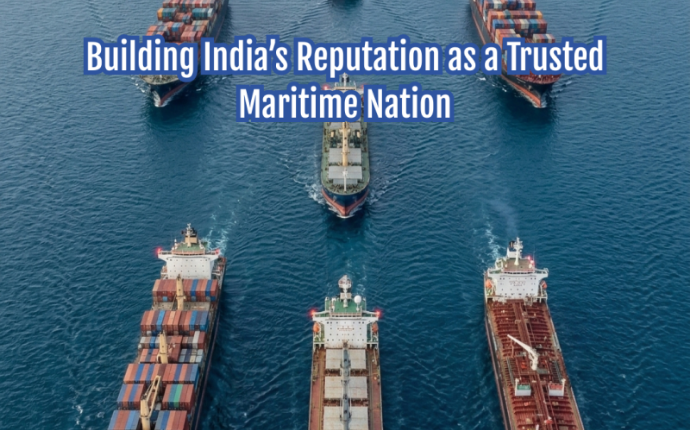
Reputation in maritime systems is not constructed through declaration. It is formed gradually through consistent participation, dependable conduct and sustained alignment with shared international expectations. Over time, nations come to be recognised not only for the scale of their maritime activity, but for the reliability with which that activity is governed, performed and sustained. Trust emerges from repeated confirmation that institutional commitments remain stable across changing conditions. It is this cumulative process that shapes whether a country is regarded as a trusted maritime nation.
Trust, within the maritime domain, operates as a structural condition rather than a symbolic attribute. Ships move across jurisdictions where regulatory authority shifts from one system to another. Workforce participation spans global fleets governed by diverse operational regimes. Commercial relationships depend on contractual obligations that extend beyond immediate enforcement. Under such circumstances, maritime activity functions efficiently only when participants trust that institutions will operate consistently even in the absence of direct oversight. Reputation becomes the mechanism through which such trust is extended across distance.
A nation’s maritime reputation reflects the coherence of its institutional environment. Governance frameworks must function predictably. Regulatory standards must remain transparent and consistently applied. Administrative processes must operate with clarity even as the scale of activity expands. Workforce systems must sustain professional competence and welfare across global deployment. Financial and operational responsibilities must be fulfilled reliably across time. Each dimension contributes incrementally to the perception that a nation’s maritime system can be depended upon.
India’s maritime presence has grown significantly in recent decades. Its economic expansion has increased the volume and complexity of trade moving through maritime channels. Its workforce participates widely across global shipping operations. Its infrastructure continues to evolve in scale and technological sophistication. Each of these developments increases India’s visibility within the global maritime landscape. Visibility, however, is not synonymous with reputation. Reputation emerges from how participation is sustained over time.
The process through which reputation forms is cumulative rather than episodic. It is shaped through the daily functioning of institutions rather than through isolated achievements. Every regulatory decision that reflects clarity and proportionality contributes to credibility. Every administrative process that operates transparently reinforces reliability. Every professional interaction that reflects competence and integrity strengthens trust. Over time, these countless interactions form the basis upon which global partners evaluate the dependability of a maritime system.
In global maritime networks, trust reduces friction. When institutions are recognised as credible, regulatory recognition extends more readily across jurisdictions. Professional qualifications are accepted with confidence. Financial commitments are regarded as secure. Operational cooperation becomes smoother because expectations remain stable. Reputation thus performs a functional role. It facilitates participation by reducing the need for continuous verification at every point of interaction.
For India, the strengthening of maritime reputation aligns closely with the continued development of institutional coherence across the sector. Domestic governance frameworks that remain aligned with international conventions signal reliability to global partners. Administrative systems that function consistently across expanding operational scale demonstrate institutional maturity. Workforce protection mechanisms that operate across jurisdictions reinforce the perception that professional participation occurs within stable and responsible structures.
The Indian Maritime Federation’s engagement across industry dialogue and policy interaction reflects awareness that reputation is shaped by the integrated performance of the maritime ecosystem. It is not produced by individual institutions acting in isolation, but by the coherence of governance, workforce systems, financial frameworks and operational practice functioning together. Dialogue that strengthens alignment among these elements contributes directly to the gradual accumulation of trust.
International maritime activity depends heavily on continuity. Ships operate across extended periods. Infrastructure remains in use for generations. Workforce participation spans long professional lifecycles. Reputation develops within this temporal framework. It reflects not momentary performance but sustained consistency across successive phases of maritime development. Nations whose institutional frameworks demonstrate reliability across changing conditions acquire reputational depth that supports long-term engagement.
India’s maritime evolution increasingly reflects this long-term perspective. As the sector expands, the importance of maintaining consistency across institutional domains becomes more pronounced. Growth introduces complexity. Complexity requires structured coordination. Where coordination remains coherent, expansion reinforces rather than dilutes reputation. Scale becomes a source of strength when supported by institutional clarity.
Global maritime governance further amplifies the importance of reputation. Participation in international regulatory frameworks involves continuous interaction with other maritime nations and institutions. Nations whose governance systems demonstrate reliability contribute constructively to the evolution of shared standards. Their perspectives carry weight because their institutional performance reflects practical credibility. Reputation thus supports influence within global maritime discourse.
Technological transformation and environmental responsibility also shape the contemporary maritime reputational landscape. The adoption of evolving operational standards requires institutions capable of integrating change while maintaining continuity. Nations that adapt proactively while preserving regulatory clarity demonstrate that their maritime systems remain responsive as well as stable. Such responsiveness strengthens international confidence.
Workforce participation provides another visible dimension of reputation. Maritime professionals represent their national institutional environment wherever they serve. Their competence, reliability and adherence to professional standards reflect the effectiveness of the systems that trained, certified and supported them. Sustained excellence in workforce participation contributes significantly to how a nation is perceived within global maritime labour markets.
Financial reliability forms an additional pillar of maritime reputation. Commercial relationships depend on confidence that obligations will be met across time and circumstance. Governance frameworks that ensure accountability while preserving operational viability signal that maritime enterprises function within stable institutional environments. Financial credibility reinforces broader perceptions of trustworthiness.
The cumulative effect of these interconnected elements is the gradual emergence of reputational stability. Nations that sustain coherence across governance, workforce development, operational performance and financial responsibility come to be recognised as dependable participants in global maritime systems. Their reputation becomes an enduring characteristic rather than a transient perception.
India’s maritime future will increasingly depend on the continued strengthening of this integrated credibility. As participation expands across global shipping networks, infrastructure development and workforce deployment, the consistency of institutional performance will determine how that participation is perceived. Reputation will shape not only how India engages with the maritime world, but how the maritime world engages with India.
Building and sustaining reputation requires ongoing institutional attention. Governance frameworks must remain aligned with evolving global standards. Administrative processes must continue to operate with transparency. Workforce protection must remain reliable across international deployment. Financial and operational commitments must be fulfilled consistently. Each element reinforces the others, creating a self-reinforcing structure of trust.
Maritime systems have always relied on trust that extends beyond immediate observation. The ocean itself represents distance, uncertainty and interdependence. Nations that operate within this environment with reliability and coherence gradually acquire reputational standing that transcends individual transactions. Their presence within global maritime systems becomes synonymous with stability.
As India continues to expand its maritime engagement, its reputation as a trusted maritime nation will be shaped not by singular achievements but by the steady performance of its institutions across time. Trust will deepen as governance remains predictable, professional capability remains consistent and participation remains aligned with shared global standards.
In the long arc of maritime development, reputation functions as a form of institutional capital. It cannot be acquired quickly, but once established it supports sustained participation, deeper integration and expanded influence. For India, building and maintaining this reputational capital represents one of the most enduring pathways through which its maritime presence can continue to grow in strength, reliability and global recognition.