Maritime systems operate across distances that separate work from immediate oversight. Ships move beyond territorial waters. Employment occurs within environments where jurisdiction may be shared or layered. Professional duties unfold in conditions that combine technical complexity, physical risk and prolonged isolation from domestic institutional support. Under such circumstances, the relationship between maritime labour and the state assumes a distinctive form. It is not confined to conventional regulatory interaction. It becomes a structured understanding through which professional commitment and institutional responsibility remain aligned across space and time.
This understanding can be described as a social contract. Not in the abstract philosophical sense often invoked in political theory, but as a practical and enduring framework through which maritime professionals and national institutions recognise mutual obligations that sustain the viability of maritime work itself. The state provides governance, protection and institutional continuity. Maritime labour provides professional capability, operational reliability and participation in the national maritime presence across global systems. Each dimension depends on the other.
The maritime profession, by its nature, requires individuals to operate in environments where the direct presence of state authority is limited. Yet the absence of physical proximity does not diminish institutional responsibility. Instead, it transforms responsibility into structured provision. The state must ensure that governance frameworks extend across the full lifecycle of maritime employment, including conditions that unfold far beyond domestic jurisdiction. Labour, in turn, sustains national maritime participation through skill, discipline and adherence to professional standards that reflect institutional credibility abroad.
This reciprocal relationship has developed gradually through the evolution of global maritime activity. Historically, seafarers often functioned with limited institutional protection, their professional security dependent largely on individual arrangements or employer discretion. Modern maritime governance reflects recognition that sustained global operations require a more stable foundation. The professional risks associated with maritime work, combined with its international character, necessitate structured frameworks through which protection, recognition and accountability remain continuous regardless of location.
India’s maritime workforce exemplifies the contemporary expression of this relationship. Indian seafarers serve across international fleets, operating within regulatory environments that intersect domestic governance with global maritime conventions. Their professional engagement represents both individual career pathways and national participation within global shipping systems. Ensuring that this engagement remains stable requires institutional arrangements that support individuals throughout their service, whether within national waters or far beyond them.
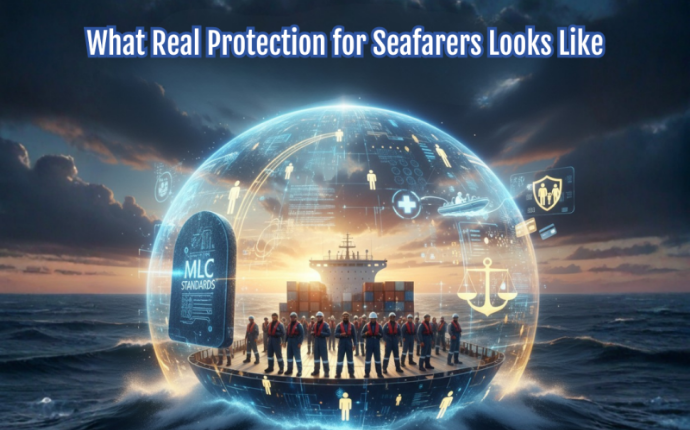
The social contract between maritime labour and the state therefore operates through multiple interrelated dimensions. Governance establishes the regulatory frameworks within which maritime work occurs. Protection ensures that individuals remain supported when professional risk materialises. Recognition affirms the legitimacy of professional qualifications across jurisdictions. Administrative systems facilitate the continuity of employment, certification and welfare across extended periods of service. Together, these dimensions form the structural environment within which maritime labour becomes a sustainable national capability.
This sustainability is not solely a matter of welfare, though welfare is an essential component. It is also a matter of strategic continuity. Maritime systems depend on long-term accumulation of professional expertise. Training requires sustained investment of time and institutional resources. Operational reliability improves with experience. National maritime presence across global systems is reinforced through continuity of participation. The social contract ensures that individuals remain willing to invest in maritime careers that require long-term commitment.
Where such a contract remains clear and reliable, maritime labour becomes a stable component of national maritime capacity. Professionals enter the sector with confidence that institutional frameworks will support them across the full arc of their careers. Experience accumulates across generations. Professional standards remain consistent. The state benefits from sustained maritime participation that extends its presence across global shipping networks.
Where the social contract becomes uncertain or fragmented, the consequences appear gradually rather than immediately. Professional commitment may become more provisional. Long-term career pathways may narrow. The continuity of experience that supports operational stability may weaken. Maritime participation becomes episodic rather than enduring. The stability of the maritime system itself becomes more dependent on short-term recruitment than on sustained professional development.
Globally, maritime economies that maintain strong and continuous workforce participation typically sustain well-defined institutional relationships between labour and governance. Protection frameworks operate with reliability across jurisdictions. Certification and professional recognition remain coherent across time. Administrative mechanisms function with clarity even as operational environments evolve. The social contract is not formally articulated at every point, but it is consistently enacted through institutional practice.
India’s maritime governance continues to evolve within this broader pattern. Alignment with international labour conventions, development of structured welfare frameworks and expansion of administrative capacity all reflect recognition that maritime labour operates within a distinct institutional environment. Protection, recognition and continuity are not optional additions to maritime activity. They are structural conditions that enable it.
The Indian Maritime Federation’s engagement across workforce and policy domains reflects awareness of the importance of maintaining coherence within this institutional relationship. Dialogue that aligns governance frameworks with operational realities supports the ongoing renewal of the social contract. As maritime systems evolve in scale and complexity, institutional relationships must adapt correspondingly to preserve continuity.
The international dimension of maritime labour adds further significance to this relationship. Professionals frequently operate within regulatory systems beyond their home jurisdiction. Yet their professional identity remains connected to the institutional frameworks that govern their training, certification and welfare. The state’s responsibility extends across these transnational environments through mechanisms that ensure protection and recognition remain effective even when direct territorial authority does not.
This transnational extension of institutional responsibility distinguishes maritime labour from many other professional domains. The social contract is not confined within national boundaries. It accompanies individuals across global operational networks. Its effectiveness therefore depends on the coherence of governance frameworks that operate in alignment with international standards and cooperative mechanisms.
Technological and regulatory transformation within maritime systems continually reshapes the conditions under which this relationship functions. Environmental regulation, digitalisation of operations and evolving safety requirements alter professional responsibilities and competencies. The social contract must remain adaptable to these changes while preserving its fundamental structure. Protection must evolve alongside risk. Recognition must evolve alongside professional standards. Governance must evolve alongside operational complexity.
India’s maritime future will continue to depend significantly on the stability of this evolving relationship. The country’s global maritime presence is sustained through the participation of its workforce across international shipping systems. Ensuring that this participation remains continuous requires institutional frameworks capable of supporting individuals throughout the full spectrum of professional experience.
The social contract between maritime labour and the state is therefore neither symbolic nor abstract. It is a practical architecture through which national maritime capability is sustained. It ensures that individuals who carry the responsibilities of maritime work remain supported by institutions whose authority extends beyond geographic proximity. It ensures that professional commitment is matched by institutional continuity.
In the long history of maritime activity, systems that have endured have done so not only through ships and trade, but through structured relationships between those who govern and those who serve. The stability of maritime labour reflects the reliability of the institutional environment within which it operates. Where that environment remains coherent, participation becomes sustainable. Where participation becomes sustainable, maritime capability becomes enduring.
As India’s maritime system continues to expand and integrate globally, the social contract between maritime labour and the state will remain one of its most fundamental structural elements. It binds professional capability to institutional responsibility. It sustains participation across distance and time. And in doing so, it anchors the human dimension of maritime activity within the enduring framework of national governance.