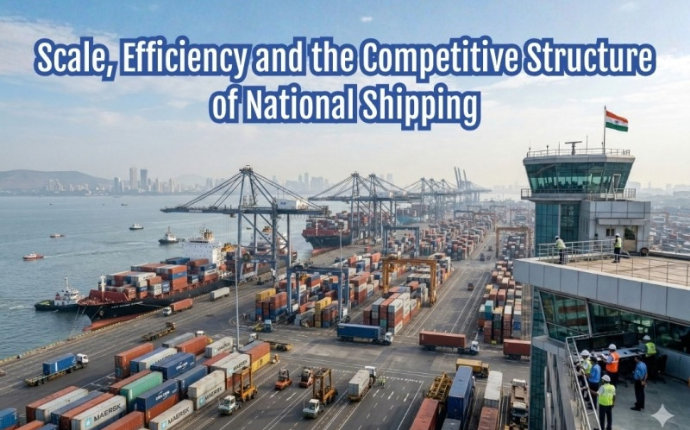
Shipping operates within an environment shaped simultaneously by global integration and national structure. Vessels move across oceans without regard to political boundaries, yet the systems that support their ownership, operation and management are rooted within national institutional frameworks. Every maritime economy therefore develops a characteristic competitive structure reflecting how its shipping capacity is organised, financed and governed. Within this structure, two forces exert particular influence over long-term performance: scale and efficiency.
Scale in national shipping refers not simply to the size of fleets or the volume of cargo transported. It reflects the aggregate capacity of a maritime system to sustain operational continuity, absorb volatility and participate meaningfully within global trade networks. Efficiency refers to the manner in which this capacity is organised and deployed. It encompasses cost structures, administrative processes, regulatory coherence and the operational coordination that allows shipping activity to function smoothly across complex environments.
The relationship between scale and efficiency shapes the competitive position of national shipping within the global maritime economy. Scale without efficiency may generate capacity but not sustained advantage. Efficiency without scale may produce operational excellence but limit influence or resilience. Long-term competitiveness emerges where both dimensions develop in alignment.
Shipping, perhaps more than most industries, rewards structured scale. Larger operational ecosystems often benefit from distributed risk, access to diversified markets and the ability to invest in technological and administrative infrastructure that supports continuous improvement. Scale allows maritime systems to stabilise performance across fluctuating trade cycles. It enables participation across multiple shipping segments and routes. It supports investment in training, maintenance and innovation that smaller systems may struggle to sustain independently.
Yet scale introduces complexity. Larger fleets require more extensive regulatory oversight. Expanded operations increase administrative demands. Diverse participation across segments of shipping requires coordination across institutional boundaries. Efficiency becomes the mechanism through which scale remains productive rather than burdensome. It ensures that the expansion of capacity does not generate proportional increases in friction or cost.
Efficiency in shipping arises from coherence across multiple domains simultaneously. Regulatory frameworks must operate with clarity so that compliance remains predictable. Administrative processes must function without unnecessary delay. Financial structures must align with operational realities so that capital remains available for productive deployment. Workforce systems must sustain professional continuity across expanding operations. When these elements function in alignment, scale enhances rather than complicates performance.
India’s maritime sector continues to evolve within this interplay of scale and efficiency. The country’s economic growth, expanding trade networks and increasing integration into global shipping routes create conditions in which national shipping capacity holds growing strategic significance. Developing scale within domestic shipping enhances economic resilience by strengthening control over the movement of goods and supporting participation across multiple segments of maritime activity.
At the same time, the effectiveness of this scale depends on the efficiency with which it is organised. Institutional coherence determines whether expansion translates into sustained competitiveness. Administrative reliability influences operational cost structures. Regulatory clarity shapes investment behaviour. Financial frameworks determine how readily enterprises can grow or modernise their fleets. The competitive structure of national shipping therefore reflects not only the quantity of capacity but the quality of institutional organisation supporting it.
Globally, maritime economies that sustain strong competitive positions often display balanced development across these dimensions. Their fleets operate within governance environments that provide stability while allowing adaptation. Administrative systems support rapid but accountable decision-making. Financial structures facilitate investment without immobilising capital unnecessarily. Operational coordination across ports, logistics networks and shipping services reduces friction within the movement of goods.
Such systems do not treat scale as an objective in isolation. They recognise that scale becomes strategically valuable only when supported by institutional efficiency that allows capacity to function productively. Expansion without organisational coherence risks generating structural strain. Efficiency without expansion may limit the ability to participate meaningfully in global shipping networks. Long-term competitiveness requires both to evolve together.
India’s maritime development increasingly reflects recognition of this interdependence. The expansion of shipping capacity, modernisation of port infrastructure and strengthening of regulatory frameworks together shape the environment within which national shipping competes globally. Each dimension contributes to the overall structure of the sector. Alignment among them determines whether scale produces resilience and efficiency produces sustained advantage.
The Indian Maritime Federation’s engagement across industry, policy and institutional dialogue reflects the importance of maintaining this alignment. Observations across the maritime ecosystem indicate that competitiveness strengthens where growth in capacity is accompanied by improvements in administrative coherence, regulatory clarity and financial adaptability. Structural balance supports sustained participation across diverse segments of shipping.
Efficiency also influences the distribution of participation within national shipping. Systems that manage scale effectively often enable diverse enterprises to operate within a coherent framework. Large operators contribute capacity and investment. Smaller or specialised enterprises provide flexibility and niche expertise. Institutional efficiency ensures that this diversity functions as a coordinated system rather than a fragmented landscape.
This diversity itself contributes to resilience. Shipping systems that accommodate multiple forms of participation can adapt more readily to changing market conditions. Different operational models respond differently to fluctuations in trade or technology. A competitive structure that supports varied participation while maintaining overall coherence enhances the capacity of the sector to remain stable across cycles of expansion and contraction.
International engagement further amplifies the importance of scale and efficiency within national shipping. Global trade networks connect maritime systems across jurisdictions where operational standards, regulatory expectations and cost structures interact continuously. Nations whose shipping sectors combine substantial capacity with efficient institutional organisation integrate more effectively into these networks. Their participation becomes stable rather than contingent.
India’s position within global maritime trade continues to strengthen as its economic presence expands. The development of a competitive national shipping structure contributes not only to domestic economic resilience but to sustained integration into global logistics systems. Scale enhances the country’s capacity to participate across trade routes. Efficiency ensures that participation remains economically viable and operationally reliable.
Technological transformation also interacts with the scale-efficiency dynamic. Digital systems, environmental compliance technologies and advanced operational platforms often require significant investment. Larger shipping ecosystems may be better positioned to absorb such costs, but their effectiveness depends on institutional frameworks capable of integrating technological change without disruption. Efficiency determines whether technological adoption enhances competitiveness or introduces complexity.
The temporal dimension of maritime investment reinforces the need for structural balance. Ships operate for decades. Infrastructure shapes economic geography for generations. Institutional arrangements supporting shipping must therefore function across extended time horizons. Scale provides continuity of capacity. Efficiency provides continuity of performance. Together, they sustain competitiveness across successive phases of maritime development.
Maritime history offers numerous examples of how this balance shapes long-term outcomes. Nations whose shipping sectors expanded without developing institutional coherence often encountered operational inefficiencies that limited sustained growth. Conversely, systems that maintained high efficiency but limited scale sometimes found their influence constrained within global networks. Durable maritime strength has typically emerged where expansion and organisation evolved together.
India’s maritime future will continue to unfold within this historical pattern. The country’s economic trajectory suggests continued growth in trade and shipping demand. Ensuring that national shipping capacity expands within frameworks that maintain institutional efficiency will be essential to sustaining long-term competitiveness. Structural balance will determine whether scale translates into resilience and whether efficiency supports expansion.
The competitive structure of national shipping is therefore not determined solely by market forces. It is shaped by how institutional frameworks organise capacity, regulate participation and support operational continuity. Scale and efficiency function as interdependent dimensions of this structure. Each amplifies the value of the other.
As India continues to strengthen its maritime presence, the alignment of scale and efficiency will remain central to shaping the future of national shipping. Capacity must grow in proportion to economic demand. Institutional organisation must evolve in proportion to expanding complexity. Where these processes remain coordinated, competitiveness becomes not a temporary advantage but an enduring characteristic of the maritime system.
In the broader architecture of global shipping, nations are recognised not only by the number of vessels they operate, but by the coherence of the systems that support them. Scale provides presence. Efficiency provides performance. Together, they define the competitive structure through which national shipping participates in the global maritime economy.