Maritime investment is rarely an expression of short-term calculation. Ships are constructed with operating lives measured in decades. Port infrastructure is developed with expectations of sustained utilisation across generations of trade. Training institutions are established to produce professional capability that matures over long career horizons. Financial commitments supporting maritime enterprise are structured around repayment cycles that extend well beyond immediate market conditions. In every meaningful sense, maritime development unfolds across extended timeframes.
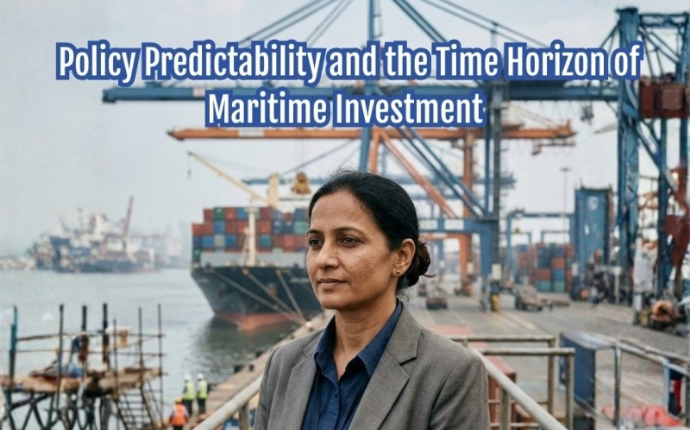
Within such an environment, the character of policy becomes inseparable from the behaviour of investment. Capital does not simply respond to opportunity. It responds to the environment within which opportunity must be sustained. Policy frameworks shape that environment by determining how regulatory conditions evolve, how administrative processes function and how institutional obligations are structured over time. Investment, in turn, aligns itself with the degree to which this environment is perceived as predictable.
Predictability in policy does not imply permanence. Maritime systems must adapt continuously to technological change, evolving safety standards, environmental regulation and shifts in global trade. Policy cannot remain static because the environment it governs is dynamic. What investment requires is not immobility, but structured evolution — a governance framework within which change occurs through processes that are transparent, coherent and proportionate.
The distinction between stability and predictability is therefore central to understanding maritime investment behaviour. Stability refers to conditions remaining unchanged. Predictability refers to the capacity to anticipate how conditions will change. Maritime investors recognise that regulatory frameworks will evolve. What shapes their decisions is whether such evolution can be understood, planned for and incorporated into long-term financial models.
The scale and structure of maritime capital amplify the importance of this distinction. Investments in vessels, infrastructure and operational systems involve commitments that cannot be easily reversed. Assets designed for long operational life must function within governance environments that evolve gradually rather than unpredictably. Financial structures supporting these assets depend on assumptions regarding regulatory continuity and administrative reliability. When policy evolution is structured, these assumptions can be integrated into planning. When policy evolution appears uncertain, planning becomes more cautious.
India’s maritime sector operates within precisely such long-term investment cycles. Expansion of domestic shipping capacity, modernisation of port infrastructure, development of maritime services and strengthening of workforce training systems all require sustained financial commitment. These commitments are made not only on the basis of present economic conditions, but on expectations regarding the institutional environment that will shape operations across decades.
Policy predictability therefore becomes an economic variable in its own right. It influences not only regulatory compliance but the cost of capital, the willingness of enterprises to scale operations and the capacity of institutions to attract sustained participation. Investors assess governance frameworks not solely in terms of current requirements, but in terms of how those requirements are likely to evolve over time.
Globally, maritime systems that attract consistent long-term investment often display clear patterns of policy evolution. Regulatory change occurs through defined consultation processes. Transitional periods are structured to allow operational adjustment. Administrative procedures remain coherent even as frameworks are updated. Participants understand not only what policy requires today, but how policy will respond to emerging conditions.
Such environments allow capital to move with confidence. Financial models incorporate anticipated regulatory shifts. Infrastructure planning aligns with projected institutional development. Workforce training reflects future competency standards rather than only present requirements. Predictability transforms policy from an external constraint into an integrated component of strategic planning.
India’s maritime governance framework increasingly reflects awareness of this relationship. As the sector expands and integrates more deeply into global shipping networks, the need to sustain investment across extended horizons becomes more pronounced. Policy evolution must therefore remain aligned not only with regulatory objectives but with the temporal realities of maritime capital.
This alignment requires structured communication between governance institutions and sector participants. Investment decisions depend on clarity regarding regulatory direction. Administrative transparency allows enterprises to anticipate procedural requirements. Predictability emerges not solely from the content of policy but from the processes through which policy is developed and implemented.
The Indian Maritime Federation engages with this dimension of sectoral development through dialogue that connects institutional decision-making with operational experience. Observations across the maritime ecosystem indicate that investment behaviour strengthens where governance frameworks communicate continuity of direction. Predictability becomes a shared institutional objective because it supports both regulatory effectiveness and economic vitality.
Policy predictability also influences technological adoption within maritime systems. Innovation in areas such as digital navigation, environmental performance and operational safety often requires significant upfront capital. Enterprises commit to such investment when regulatory frameworks provide clear pathways for integration and long-term compliance. Where policy direction remains transparent, technological transformation becomes an extension of planned development rather than a speculative risk.
The international dimension of maritime activity further reinforces the importance of predictability. Shipping enterprises operate across multiple jurisdictions, comparing governance environments in terms of reliability and coherence. Investment flows toward systems where policy evolution is understood to be structured and proportionate. Predictability becomes a competitive attribute within global maritime engagement.
India’s position within this international environment continues to strengthen as its maritime sector expands. The country’s ability to attract sustained participation, both domestic and global, depends in part on how clearly its policy frameworks communicate continuity of institutional direction. Governance that evolves transparently enhances confidence among investors whose planning horizons extend far beyond immediate market conditions.
Workforce development also reflects this temporal relationship. Training programmes prepare professionals for operational environments that will evolve over time. Certification frameworks must remain aligned with future regulatory standards. Individuals invest years in acquiring maritime expertise with the expectation that institutional recognition will remain consistent across their careers. Policy predictability therefore supports not only capital investment but professional commitment.
Maritime systems function through the alignment of multiple time horizons. Operational decisions unfold daily. Financial commitments extend across decades. Institutional development progresses gradually. Policy predictability ensures that these different temporal dimensions remain coordinated. When governance evolves in ways that participants can anticipate, long-term investment becomes compatible with ongoing adaptation.
Predictability does not eliminate uncertainty inherent in maritime activity. Markets fluctuate. Technology advances. Environmental conditions change. What policy predictability provides is a stable framework within which such uncertainty can be managed. Investors do not require certainty of outcome. They require clarity of institutional process.
Maritime history demonstrates that sustained development has often depended on governance environments where policy evolution followed discernible patterns. Nations that maintained continuity in regulatory direction while adapting to new realities attracted long-term capital and stable participation. Their maritime infrastructure expanded because investment could align with institutional trajectory.
India’s maritime future will continue to involve significant long-term investment in infrastructure, workforce capability and operational capacity. Ensuring that this investment remains robust requires policy frameworks that evolve through transparent and coherent processes. Predictability supports the confidence necessary for capital to commit itself across extended horizons.
In the broader architecture of maritime development, policy functions as a temporal guide. It shapes not only present conditions but expectations regarding the future. Where policy communicates continuity of direction, investment moves forward with assurance. Where policy appears uncertain, investment becomes cautious even when opportunity exists.
Maritime systems depend on navigation not only across physical waters but across time itself. Policy predictability provides the institutional chart through which long-term investment navigates evolving conditions. It aligns governance with the temporal realities of maritime capital and transforms regulatory frameworks into foundations for sustained development.
As India continues to strengthen its maritime capacity, the predictability of policy evolution will remain one of the most significant factors shaping investment behaviour. It will determine how confidently enterprises plan for the future, how effectively infrastructure development proceeds and how steadily the sector integrates new technologies and standards.
In the quiet relationship between governance and capital, predictability performs a profound function. It converts policy from a variable into a framework. It allows investment to extend beyond immediate conditions into long-term commitment. And it sustains the continuity through which maritime development becomes not episodic expansion, but enduring progress.