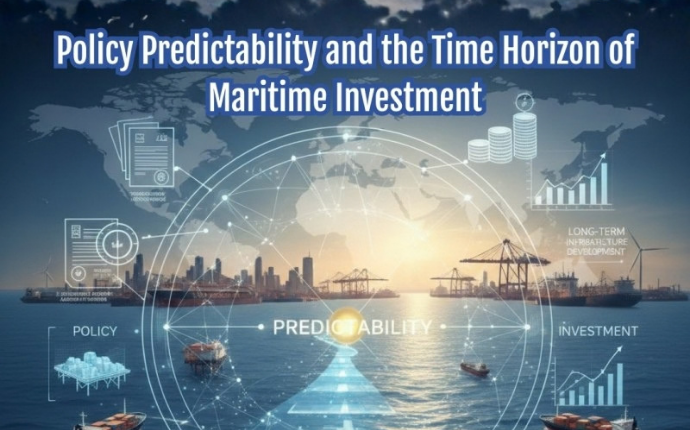
Maritime investment is fundamentally long-term.
Ships operate for decades. Ports serve generations of trade. Training systems shape careers that span lifetimes. In such an environment, policy becomes more than regulation — it becomes the framework through which investment navigates time.
Investors do not expect policy to remain unchanged. They expect it to evolve predictably.
The distinction between stability and predictability is critical:
- Stability means no change.
- Predictability means change that can be anticipated.
Maritime capital aligns with governance environments where evolution follows clear processes, transparent consultation and proportionate transition. When policy direction is understood, investment expands confidently. When uncertainty dominates, even opportunity invites caution.
Policy predictability influences more than capital flows. It shapes technological adoption, workforce development and infrastructure planning. Institutions that communicate continuity enable enterprises to plan beyond immediate market cycles.
As India deepens integration into global shipping networks, predictable policy evolution becomes an economic asset in itself. Governance clarity reduces friction between regulation and growth, allowing adaptation without disruption.
Maritime development unfolds across multiple time horizons simultaneously — daily operations, decade-long investments and generational institutional growth.
Predictable policy aligns them all.
#MaritimeInvestment #PolicyPredictability #ShippingEconomics #MaritimeStrategy