Reform is often misunderstood as disruption.
In maritime systems, lasting reform rarely arrives through sudden correction. It emerges through institutional maturity — when governance evolves in step with the growing complexity of the sector it supports.
Shipping, infrastructure, workforce development and regulatory frameworks operate across long investment cycles. Change in such systems is cumulative, not abrupt. When reform is driven solely by crisis, it may restore balance temporarily. When driven by maturity, it strengthens stability itself.
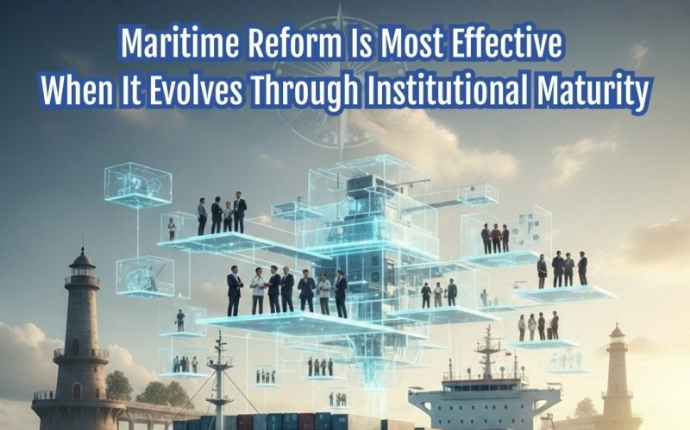
Institutional maturity allows governance to observe its own evolution. It enables recalibration before strain becomes visible. Reform becomes developmental rather than reactive — aligning institutions with present realities while preserving continuity.
India’s maritime sector increasingly reflects this phase of evolution. Expansion in trade, workforce mobility and global engagement has layered new responsibilities onto existing frameworks. The challenge is not replacement, but integration — ensuring that governance functions as a coherent system rather than an accumulation of past solutions.
Mature reform is often quiet. It may not appear dramatic, yet its effects are profound. Predictable adjustment sustains investment confidence, professional continuity and operational stability across decades.
Maritime strength is not measured by how quickly systems change, but by how intelligently they adapt.
Reform grounded in institutional maturity does not interrupt stability. It preserves it.
#MaritimeGovernance #InstitutionalMaturity #PolicyEvolution #IndianMaritimeFederation