Every functioning maritime system rests on a foundation that is rarely measured directly yet constantly experienced by those who operate within it. This foundation is regulatory confidence. It is the quiet assurance that governance will function predictably, that standards will be applied consistently and that institutional response will remain stable across changing conditions. It is not merely trust in authority, but trust in the continuity of the framework through which authority is exercised.
In sectors where activity unfolds across vast distances and multiple jurisdictions, such confidence becomes more than a psychological comfort. It becomes an economic condition. Decisions to invest, operate, employ and expand are shaped not only by market opportunity but by the degree to which the regulatory environment is perceived as coherent, reliable and proportionate. Maritime participation, in particular, depends on this assurance because the costs of uncertainty extend far beyond administrative inconvenience. They influence capital allocation, operational planning and long-term strategic commitment.
Regulation, at its core, exists to provide structure within complexity. Maritime operations involve exposure to risk that is technical, environmental, financial and human simultaneously. Without clear regulatory frameworks, this exposure would remain unmanaged and potentially destabilising. Standards governing vessel safety, labour protection, certification, environmental compliance and financial responsibility create the conditions under which maritime activity can occur with accountability.
Yet the presence of standards alone does not produce regulatory confidence. Confidence arises from the experience of how those standards function in practice. It emerges when processes remain predictable, when institutional interpretation remains consistent and when administrative pathways operate with clarity across time. Participants in the maritime system observe not only what regulation requires, but how regulation behaves.
This behavioural dimension of governance shapes economic participation in subtle but profound ways. Enterprises plan investment cycles around expected regulatory continuity. Workforce engagement depends on stable certification and welfare frameworks. Financial institutions assess exposure based on the predictability of compliance obligations. Each of these decisions reflects an underlying judgment about whether the regulatory environment can be relied upon to remain coherent as activity unfolds.
India’s maritime sector operates within a governance framework that has evolved through sustained institutional development. Regulatory systems address a wide range of responsibilities, from technical safety standards to labour welfare, from financial assurance to international compliance alignment. These frameworks reflect commitment to maintaining both domestic accountability and global credibility. Their effectiveness is expressed not only in formal structure but in how participants experience them in daily operation.
As maritime activity expands in scale and diversity, the economic importance of regulatory confidence increases proportionately. Expansion introduces new participants, new forms of engagement and new operational contexts. Each of these must integrate into existing governance structures. Where regulatory pathways remain clear and consistent, integration occurs smoothly. Where interpretation varies or processes become difficult to anticipate, adjustment requires additional effort.
This additional effort represents more than administrative burden. It represents economic friction. Time allocated to managing uncertainty is time not allocated to productive activity. Financial resources reserved for precautionary adjustment cannot simultaneously support expansion. Decision-making becomes more cautious when outcomes depend on procedural interpretation rather than structured expectation.
Globally, maritime economies that sustain strong participation over extended periods often display high levels of regulatory confidence. Standards are rigorous, yet their application is predictable. Administrative systems are comprehensive, yet their operation remains navigable. Institutional authority is clear, yet its exercise follows established patterns. Participants engage not because regulation is minimal, but because regulation is reliable.
Reliability allows economic actors to plan with horizon rather than hesitation. Investment becomes oriented toward growth rather than precaution. Operational continuity becomes easier to maintain because administrative interaction does not require constant renegotiation. Confidence becomes embedded within the system’s functioning, reducing the need for continuous verification of institutional stability.
India’s maritime ecosystem increasingly reflects awareness of the relationship between regulatory behaviour and economic participation. As the sector continues to deepen its engagement within global shipping networks, the consistency and clarity of governance frameworks influence how confidently enterprises commit resources and how readily professionals engage in long-term maritime careers.
This relationship extends across multiple dimensions. Financial participation depends on predictable assurance requirements. Workforce mobility depends on stable certification and welfare administration. Operational planning depends on clear procedural timelines. Institutional dialogue depends on structured communication channels. Each dimension contributes to the broader environment within which maritime activity unfolds.
Regulatory confidence does not eliminate complexity. Maritime governance must remain comprehensive because the environment it governs is inherently complex. What confidence provides is orientation within that complexity. Participants understand not only what is required but how requirements are fulfilled across different contexts. Procedures may be detailed, but they are coherent. Standards may be rigorous, but they are stable.
The absence of such confidence does not necessarily produce immediate disruption. Maritime systems are resilient and capable of functioning under varied conditions. Yet over time, uncertainty influences behaviour. Investment decisions become more conservative. Operational flexibility narrows. Institutional interaction requires greater effort to maintain continuity. The system continues to function, but its economic energy becomes partially absorbed by managing unpredictability.
India’s maritime development trajectory places increasing importance on sustaining regulatory environments that support both accountability and economic vitality. As participation expands across domestic and international dimensions, the predictability of governance becomes a strategic asset. It enables enterprises to scale operations, encourages financial institutions to engage confidently and supports workforce participation across global markets.
The Indian Maritime Federation engages with this dimension of sectoral development through its interaction with industry participants and institutional frameworks. Observations across the maritime landscape suggest that economic resilience strengthens where regulatory behaviour remains consistent and transparent. Dialogue that supports clarity of governance therefore contributes not only to institutional integrity but to economic vitality as well.
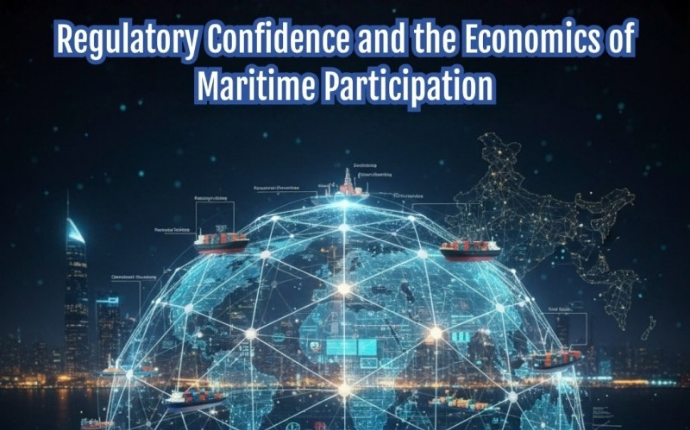
Regulatory confidence also plays an important role in shaping international perception. Maritime activity is inherently global. Vessels operate across jurisdictions where institutional credibility is continuously observed and evaluated. Nations whose regulatory environments function with coherence and predictability attract sustained engagement because participants can integrate operations without disproportionate uncertainty.
This international dimension reinforces the domestic importance of regulatory confidence. Consistency within national governance contributes directly to credibility within global maritime systems. Economic participation flows toward environments where institutional behaviour remains stable across time, supporting both operational continuity and financial predictability.
As India continues to expand its maritime presence, the economic value of regulatory confidence will remain closely linked to the sector’s growth trajectory. Governance frameworks that maintain clarity, consistency and proportionality will support participation across diverse scales of enterprise. They will allow capital to be deployed with assurance. They will enable workforce engagement to remain stable across evolving conditions.
Maritime systems have always required navigation not only across physical waters but across institutional structures. Ships rely on charts to traverse uncertain seas. Economic actors rely on regulatory confidence to navigate complex governance environments. Where charts are clear, movement is assured. Where governance is coherent, participation becomes sustainable.
In the long development of maritime economies, regulatory confidence has often functioned as one of the least visible yet most influential forms of infrastructure. It does not appear in physical statistics or financial accounts, yet it shapes how effectively all other forms of infrastructure are used. It transforms governance from a set of rules into an environment within which activity can proceed with continuity.
As India’s maritime future continues to unfold across expanding horizons, the strength of this invisible infrastructure will shape not only how the system is governed but how fully it is able to grow. Confidence in regulation becomes confidence in participation. Confidence in participation becomes continuity of development. And continuity of development becomes the enduring foundation of maritime strength.