Maritime strength is often described through visible markers. Fleet expansion, port infrastructure, cargo throughput, workforce scale and global trade participation all provide measurable indicators of a nation’s maritime presence. These elements reflect investment, operational capability and strategic positioning. They are essential, and they shape how maritime power is perceived internationally.
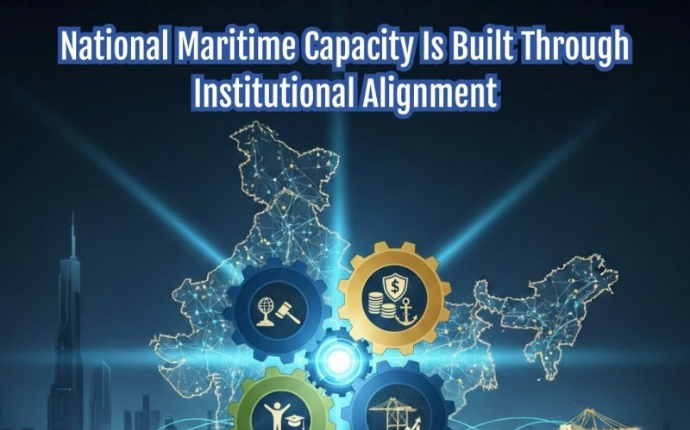
Yet beneath these visible indicators lies another dimension that determines how effectively maritime capacity develops over time. It is less tangible but no less consequential. This dimension is institutional alignment — the degree to which the various systems that govern, finance, regulate and support maritime activity function in coordinated coherence rather than parallel isolation.
Maritime systems are inherently interdependent. Regulation interacts with finance. Workforce development interacts with operational requirements. Welfare frameworks intersect with compliance obligations. Commercial activity depends on administrative responsiveness. Each institutional domain performs a distinct function, yet none operates independently of the others. The effectiveness of the maritime system as a whole depends on how these domains interact.
Institutional alignment refers to the condition in which these interactions occur with consistency and clarity. Policies support operational realities. Financial mechanisms reinforce regulatory objectives. Administrative processes correspond with commercial timelines. Welfare structures integrate with employment frameworks. The system functions not as a collection of separate institutional components but as a coordinated environment through which maritime activity flows with continuity.
Where alignment is strong, capacity develops organically. Investment decisions correspond with regulatory expectations. Workforce participation grows within stable welfare frameworks. Enterprises operate with confidence that institutional pathways will support rather than obstruct operational continuity. Governance functions predictably because responsibilities across institutional domains are clearly interrelated.
Where alignment is limited, capacity may still grow, but the process becomes more effort-intensive. Institutional domains operate effectively within their own boundaries yet require continuous coordination to manage interaction. Adjustments must be negotiated rather than embedded. Administrative effort increases even when policy objectives remain consistent. Growth occurs, but with greater reliance on institutional mediation.
India’s maritime sector now operates within a scale and complexity that makes institutional alignment increasingly significant. The country’s maritime workforce engages globally across diverse employment environments. Shipping enterprises operate within both domestic and international commercial frameworks. Regulatory systems must maintain alignment with global conventions while responding to national priorities. Financial structures support compliance, welfare and operational continuity simultaneously.
Each of these institutional domains has evolved to address specific responsibilities. Certification and training frameworks support professional competence. Regulatory structures ensure safety and accountability. Financial mechanisms provide assurance that obligations will be met. Welfare systems protect individuals across dispersed operational environments. Administrative processes coordinate interaction among these domains. Each element functions with defined purpose. The collective effectiveness of the system depends on how they function together.
Institutional alignment does not require uniformity. Distinct responsibilities must remain distinct. What alignment requires is coherence — clarity regarding how institutional functions connect and how their interaction supports shared objectives. When governance, finance, welfare and operations move in parallel rather than in coordination, the system must expend effort to maintain continuity. When they are aligned structurally, continuity becomes inherent.
Historically, maritime economies that have sustained long-term expansion often display high degrees of institutional alignment. Regulatory frameworks evolve in dialogue with industry experience. Financial assurance mechanisms support rather than constrain operational adaptation. Workforce development reflects both labour market conditions and welfare commitments. Administrative structures facilitate interaction across domains rather than requiring constant negotiation among them.
Such alignment rarely emerges spontaneously. It develops through sustained institutional maturity — the gradual recognition that sectoral strength depends not only on the performance of individual systems but on the coherence of their interaction. As maritime activity expands, the cost of misalignment becomes more visible. Delays in administrative coordination influence commercial planning. Financial structures designed for one domain may affect capacity in another. Welfare provisions interact with employment frameworks in ways that require careful integration.
India’s maritime ecosystem is now at a stage where these interactions carry growing significance. Expansion in scale has brought expansion in institutional complexity. Ensuring that this complexity functions with coherence becomes central to sustaining long-term growth. Institutional alignment does not represent structural consolidation. It represents structured coordination — the capacity of distinct systems to operate in mutually reinforcing ways.
The implications of alignment extend beyond operational efficiency. They influence confidence across the maritime community. Enterprises invest where institutional pathways are predictable. Professionals engage where governance frameworks provide continuity of protection. International partners collaborate where regulatory and administrative structures operate with clarity. Alignment, therefore, contributes directly to credibility, and credibility supports sustained engagement.
Institutional alignment also shapes the pace at which reform or innovation can be integrated. When systems are structurally coordinated, adjustment within one domain can be absorbed by others without disruption. When domains operate in isolation, change requires complex recalibration across multiple interfaces. The capacity for adaptation becomes slower and more dependent on procedural coordination.
The Indian Maritime Federation observes the importance of institutional alignment through its engagement across regulatory bodies, industry participants and policy environments. Experience indicates that sectoral resilience strengthens when institutional relationships are structured rather than incidental. Dialogue that connects governance, finance, operations and welfare contributes to this structural coherence.
Alignment does not imply centralisation of authority. It implies clarity of interaction. Each institution retains its mandate. What changes is the framework through which mandates relate to one another. Over time, such frameworks reduce friction, enhance responsiveness and allow maritime capacity to expand without proportional increase in administrative complexity.
As India continues to deepen its maritime engagement within global trade systems, the coherence of its institutional environment will increasingly shape the trajectory of its development. Physical infrastructure and commercial capability provide visible capacity. Institutional alignment provides functional capacity — the ability of the system to operate smoothly across expanding activity.
National maritime strength is therefore not built solely through ships, ports or trade volume. It is built through the relationships among the institutions that sustain those elements. Where these relationships are structured, predictable and mutually reinforcing, growth proceeds with continuity. Where they require constant mediation, growth proceeds with effort.
Maritime systems depend on coordination across distance. Institutional alignment is the domestic expression of that same principle. It ensures that the structures supporting maritime activity move together rather than in parallel. It allows governance, finance, welfare and enterprise to operate as components of a single evolving system.
In the long arc of maritime development, nations that have achieved durable maritime capacity have done so not only by expanding their physical and commercial assets but by strengthening the coherence of the institutions that sustain them. Alignment transforms complexity from a burden into a capability. It allows diverse institutional functions to combine into a system whose strength lies not only in its individual parts but in the clarity of their connection.
As India’s maritime future continues to unfold, institutional alignment will remain one of the quiet but decisive forces shaping its capacity to grow, adapt and sustain its presence within the global maritime landscape.