Small Shipowners and the Structural Diversity of Maritime Economies
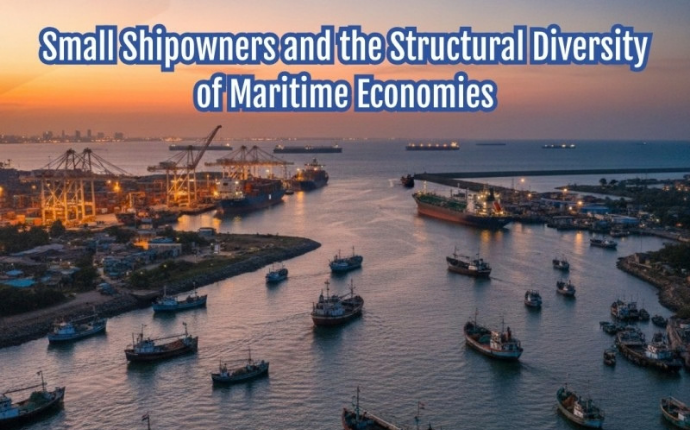
Maritime economies rarely grow through scale alone. While large fleets, major operators and global trade routes often define the visible profile of a nation’s maritime presence, the underlying structure of the sector is usually far more layered. Beneath the scale that attracts international attention exists a wide spectrum of participation—enterprises that differ in size, capital capacity, operational reach and market focus. This diversity is not incidental. It is structural.
Small and medium shipowners form one of the most significant components of this structural diversity. Their presence reflects the distributed nature of maritime commerce, where opportunities arise across regional routes, specialised cargo segments, coastal trade and niche operational environments that large operators may not always serve directly. These enterprises operate within economic spaces that require flexibility, local knowledge and responsiveness to conditions that change quickly and sometimes unpredictably.
In many maritime economies, smaller operators have historically played an essential role in sustaining continuity across segments that might otherwise remain underserved. They provide connectivity across regional trade corridors. They support supply chains that depend on adaptable scheduling. They contribute to employment patterns that are geographically distributed rather than concentrated within major hubs. Their participation broadens the operational base of the maritime system, making it more resilient to concentration risk.
India’s maritime landscape reflects this structural reality with particular clarity. The country’s extensive coastline, regional trading patterns and evolving domestic shipping environment create conditions in which participation across multiple scales is both natural and necessary. Large operators contribute to international competitiveness and major cargo flows. Smaller and emerging shipowners contribute to the distributed functioning of maritime activity across diverse economic and geographic contexts.
Structural diversity of this kind supports resilience because it reduces dependence on any single category of participant. When activity is distributed across varied operational scales, the system retains flexibility. It can respond to changes in market demand, regional trade dynamics or regulatory conditions without requiring uniform adjustment across all segments simultaneously. Diversity, in this sense, functions as a stabilising characteristic of maritime economies.
Yet structural diversity also introduces complexity in how governance and financial frameworks interact with different categories of participation. Regulatory systems designed to ensure safety, accountability and compliance must apply consistently across the sector. Financial assurance mechanisms must provide confidence that obligations will be fulfilled. Welfare protections must operate uniformly across the workforce. These requirements are essential to maintaining institutional credibility.
At the same time, the capacity to meet such requirements varies across enterprises of different scale. Large operators typically possess financial structures and administrative capacity proportionate to their operational scope. Smaller operators, while fully committed to regulatory and welfare standards, may experience these requirements within financial environments that are inherently more constrained. The structural challenge lies not in the standards themselves but in how systems accommodate diversity of scale while maintaining uniformity of responsibility.
Globally, maritime economies that sustain broad participation across enterprise size often develop governance and financial architectures that recognise this structural variation. The objective is not to differentiate standards but to ensure that mechanisms through which standards are met function proportionately across different operational contexts. Where systems achieve this balance, diversity remains an asset rather than becoming a source of uneven participation.
India’s maritime ecosystem continues to evolve within precisely such considerations. The expansion of domestic shipping, the aspiration to strengthen national maritime capacity and the ongoing development of regulatory frameworks all intersect with the structural presence of enterprises across varied scales. Ensuring that the system supports participation broadly while maintaining consistent standards is a central feature of institutional maturation.
The economic importance of small shipowners extends beyond their immediate operational contribution. They represent pathways through which maritime enterprise develops organically. Many larger operators originate from smaller beginnings, expanding over time as experience accumulates and financial capacity grows. A system that supports the continuity of smaller enterprises therefore supports the long-term expansion of national maritime capability itself.
Participation at smaller scale also contributes to the diffusion of maritime knowledge and experience across wider segments of the economy. Operational familiarity with shipping activity becomes distributed rather than concentrated. Regional engagement with maritime commerce deepens. Economic linkages between coastal communities and national trade networks become more direct. These effects reinforce the maritime character of the economy in ways that extend beyond aggregate cargo statistics.
Financial structure plays a particularly significant role in sustaining this diversity. Where financial assurance mechanisms require substantial immobilisation of capital, the relative burden may differ across enterprises depending on available resources. Large operators may absorb such requirements within broader financial capacity. Smaller operators may experience greater proportional impact even when absolute obligations remain the same. The structural effect is not difference in responsibility but difference in financial elasticity.
Maintaining diversity therefore often involves attention to how financial architecture interacts with varied capital structures across the sector. Mechanisms that distribute exposure or allow financial assurance to operate dynamically can support stability while preserving broader participation. The objective is not to reduce protection but to organise it in ways that sustain the system’s distributed character.
India’s maritime community increasingly recognises the importance of this structural perspective. The strength of national shipping does not depend solely on aggregate tonnage or fleet size. It depends on the depth and breadth of participation across different operational levels. A system that supports enterprises at multiple stages of development creates continuity of growth and resilience of structure.
The Indian Maritime Federation engages with these considerations through its interaction with stakeholders across the spectrum of maritime enterprise. Observations across the sector indicate that structural diversity contributes significantly to long-term stability. Supporting frameworks that enable this diversity to function effectively therefore aligns with the broader objective of strengthening national maritime capacity.
In many respects, the presence of small and emerging shipowners reflects the maritime economy’s adaptive character. They operate within spaces that require responsiveness to local conditions, specialised knowledge and incremental growth. Their contribution may not always be measured in large-scale metrics, but it is embedded in the continuity of activity that sustains the system between major flows of commerce.
As India continues to deepen its maritime engagement and expand its shipping capacity, the structural role of diverse enterprise participation will remain central. Systems that support participation across scales tend to exhibit greater resilience because they do not rely on uniformity of structure. They accommodate variation while maintaining coherence.
Maritime economies, like the seas they navigate, rarely remain static. They evolve through movement across changing conditions. Diversity of participation allows this movement to occur with flexibility rather than rigidity. It allows growth to emerge from multiple directions simultaneously. It ensures that expansion does not depend solely on concentration of capacity but also on continuity of opportunity.
Small shipowners, therefore, represent more than a segment of maritime enterprise. They represent one of the structural foundations upon which resilient maritime economies are built. Their presence reflects the distributed nature of maritime activity. Their continuity supports the system’s adaptability. Their growth contributes to the expansion of national capacity over time.
In the quiet architecture of maritime development, structural diversity remains one of the most enduring sources of strength. It allows systems to expand without losing balance, to adapt without losing continuity and to grow without losing the capacity to sustain participation across the full breadth of maritime life.