Risk Pooling and Collective Security in Maritime Systems
Maritime activity has always required a particular kind of courage. Not the dramatic courage often associated with facing the sea’s physical power, but a quieter, more structural form of courage — the willingness to engage continuously with uncertainty. Ships depart without full knowledge of what conditions may arise. Commercial commitments are made across timeframes that cannot fully predict economic fluctuation. Human labour is deployed into environments where distance itself becomes a form of exposure. The maritime world has never been built on certainty. It has been built on the management of uncertainty.
Over centuries, one of the most enduring responses to this reality has been collective security. Long before modern regulatory regimes or formalised insurance markets existed, maritime communities recognised that risk at sea rarely affects individuals in isolation. It moves through networks — through trade routes, employment chains, financial commitments and shared infrastructure. When exposure is shared, stability depends not on individual capacity to absorb loss, but on collective capacity to distribute it.
This principle, now widely described as risk pooling, represents one of the most fundamental structural ideas in maritime economics. It is not merely a financial technique. It is a systemic response to an environment where risk is persistent, dispersed and often unpredictable in timing. Risk pooling transforms exposure from something borne individually into something managed collectively. It converts isolated vulnerability into shared resilience.
In maritime systems of limited scale, informal forms of collective security once sufficed. Merchants shared the financial consequences of lost cargo. Early maritime ventures distributed exposure across multiple investors. Mutual assistance arrangements evolved among seafaring communities. These practices were not always formalised, but they reflected an intuitive understanding that uncertainty becomes manageable when it is distributed.
As maritime commerce expanded, informal arrangements gradually gave way to structured mechanisms. Insurance markets emerged to provide organised frameworks for risk sharing. Classification systems standardised technical expectations to reduce preventable loss. Financial instruments evolved to secure obligations in advance. Welfare protections developed to address the human consequences of maritime exposure. Each of these institutional developments represented an effort to stabilise an environment defined by variability.
Yet even as these structures matured, an important distinction remained. Many mechanisms continued to operate at the level of individual responsibility. A vessel owner secured coverage for a particular asset. An employer fulfilled obligations toward a particular workforce. A financial instrument guaranteed a specific liability. These arrangements provided protection, but often within boundaries that reflected individual participation rather than systemic exposure.
As maritime sectors expand and interconnect, the limits of individually bounded protection become more visible. Modern maritime systems do not operate as collections of isolated actors. They function as interconnected networks where operational continuity depends on the stability of multiple participants simultaneously. A disruption affecting one segment of the system often produces consequences that extend beyond its immediate origin. Financial strain in one area may influence operational capacity in another. Welfare-related events may require coordination across institutional boundaries. Risk, in contemporary maritime environments, rarely remains confined.
This interconnectedness changes the economic meaning of security. Protection is no longer solely a matter of ensuring that each participant can meet its own obligations independently. It becomes a matter of ensuring that the system as a whole can absorb disruption without cascading instability. Risk pooling, in this context, evolves from a financial convenience into a structural necessity.
India’s maritime sector increasingly reflects this systemic reality. The scale of its seafaring workforce, the diversity of its shipping enterprises and the complexity of its regulatory environment all contribute to an ecosystem in which exposure is widely distributed. Thousands of maritime professionals operate across global waters. Numerous enterprises engage with international markets that fluctuate continuously. Regulatory responsibilities intersect across administrative domains. Financial commitments support activity that spans multiple jurisdictions.
Within such an environment, risk cannot be fully stabilised through arrangements that remain narrowly segmented. Individual safeguards remain important, but their effectiveness depends on the broader stability of the system within which they operate. A financially secure enterprise benefits from functioning supply chains. A protected seafarer depends on responsive welfare mechanisms across institutional boundaries. A regulatory framework relies on the financial resilience of the sector it governs. Each component supports the others.
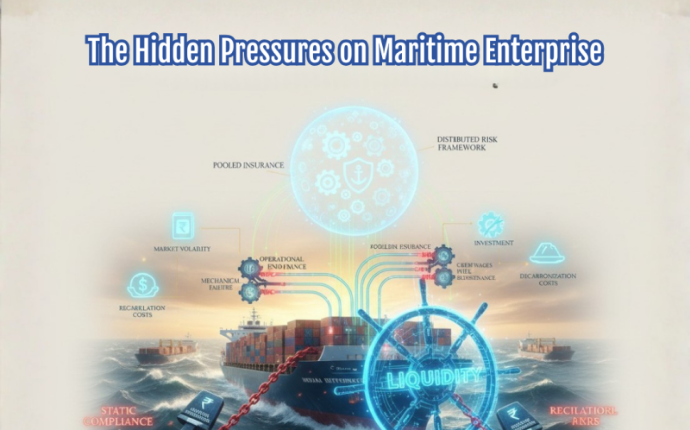
Risk pooling provides a structural means of recognising this interdependence. By distributing exposure across broader participation, it reduces the concentration of vulnerability that can arise when risk is managed in isolation. Loss becomes an event absorbed collectively rather than a shock borne disproportionately by those directly affected. Stability becomes a shared outcome rather than an individual achievement.
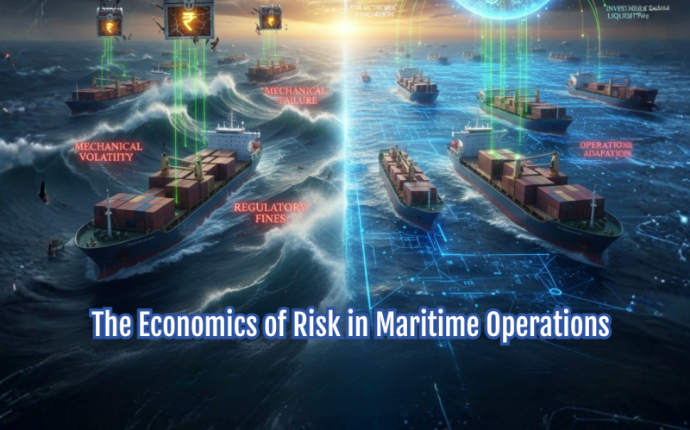
The economic implications of this shift are profound. When risk is pooled effectively, capital that would otherwise remain immobilised as precaution can function more productively. Enterprises retain greater liquidity to support operational continuity. Welfare mechanisms gain predictable financial backing. Regulatory assurance becomes grounded in systemic capacity rather than individual guarantee alone. Confidence within the sector increases because protection is understood as embedded rather than contingent.
Equally significant is the psychological dimension of collective security. Maritime professionals and enterprises operate within environments that demand sustained engagement with uncertainty. Confidence in the system’s ability to absorb disruption influences how decisions are made, how investment is pursued and how participation is sustained over time. Where protection is distributed broadly and predictably, engagement becomes more assured. Where exposure remains concentrated and uncertain, caution becomes a defining feature of behaviour.
Globally, sectors that have embraced structured risk pooling often demonstrate higher degrees of resilience under stress. Adverse events, when they occur, are absorbed through mechanisms designed to distribute impact rather than amplify it. Recovery proceeds without prolonged instability because financial capacity has been organised in advance. Institutional response becomes coordinated rather than reactive. The system remains functional even when individual components experience strain.
India’s maritime ecosystem is positioned within a period where the potential value of such systemic resilience is becoming increasingly apparent. Continued expansion in maritime employment and commercial engagement introduces corresponding expansion in exposure. The capacity to sustain growth without proportional increase in vulnerability depends on how effectively risk is organised across the system as a whole.
The movement toward structured collective security does not diminish individual responsibility. On the contrary, it reinforces it by situating responsibility within frameworks that ensure obligations can be fulfilled under diverse conditions. Participation in a risk pool requires contribution. Stability arises because responsibility is shared, not avoided. The distinction lies in how that responsibility is carried — individually and potentially unevenly, or collectively and proportionately.
Within India’s maritime community, awareness of the systemic nature of risk has been gradually deepening. Stakeholders increasingly recognise that long-term stability depends not only on the strength of individual actors but on the coherence of the structures that connect them. Risk pooling represents one of the mechanisms through which this coherence can be expressed in financial and operational terms.
The Indian Maritime Federation observes this evolving understanding through its engagement with industry participants, financial institutions and policy environments across the sector. Experience indicates that resilience strengthens when exposure is organised in ways that reflect the interconnected nature of maritime activity. Supporting dialogue around collective security mechanisms therefore becomes part of supporting the stability of the system itself.
As India’s maritime sector continues to expand its global presence, the importance of structured risk distribution will only increase. Exposure will grow in scale and diversity. Operational interdependence will deepen. Financial and welfare systems will encounter greater complexity. Under such conditions, the capacity to absorb uncertainty collectively becomes one of the most significant determinants of sustained stability.
The sea has always required those who depend upon it to recognise a simple truth: no voyage is undertaken entirely alone. Even when a vessel sails under a single flag, it moves within a system sustained by many actors whose fortunes are interconnected. Risk pooling is the institutional expression of this truth. It acknowledges that uncertainty, when shared, becomes manageable — and that stability, when organised collectively, becomes durable.
In the quiet architecture of maritime systems, collective security remains one of the most enduring foundations upon which confidence is built. As India’s maritime future continues to unfold, the strength of that foundation will shape not only how risk is absorbed, but how confidently the sector continues to move forward across the uncertain waters that have always defined its domain.