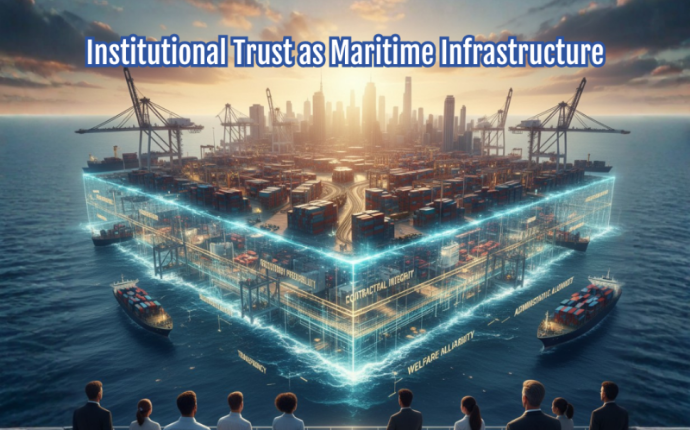
Infrastructure is often understood in physical terms. Ports, terminals, vessels, logistics corridors and communication networks form the visible architecture through which maritime trade moves. These structures are tangible, measurable and immediately recognisable as the foundations of economic activity. They enable movement, facilitate exchange and sustain the operational rhythm of global commerce. Without them, maritime systems would simply not function.
Yet alongside this visible infrastructure exists another form that is less apparent but equally essential. It cannot be seen on charts or measured in tonnage, but it determines whether physical systems operate with continuity and confidence. This is institutional trust. It is the assurance that regulatory decisions will be predictable, that commitments will be honoured, that responsibilities will be fulfilled and that systems will respond reliably when tested. Institutional trust does not move cargo or propel vessels, but it enables every interaction that makes movement possible. In this sense, it functions as infrastructure of a different kind—structural, enabling and indispensable.
Maritime activity depends on trust in ways that few other sectors do. Shipping operates across jurisdictions that differ in law, administration and economic context. Contracts are executed between parties who may never meet in person. Crews are deployed across distant waters under conditions where direct institutional presence is limited. Financial commitments extend across timeframes that require confidence in future stability. Each of these relationships rests on the expectation that systems will behave consistently, that obligations will be honoured without uncertainty and that governance frameworks will function as intended regardless of circumstance.
Within such an environment, trust is not merely a desirable attribute. It is an operational requirement. A vessel entering port relies on confidence that regulatory procedures will unfold predictably. A seafarer accepting an assignment relies on assurance that welfare protections will remain dependable across locations. An investor allocating capital relies on stability in the institutional environment that governs financial exposure. These expectations are rarely articulated explicitly because they are assumed as part of normal functioning. When trust is present, systems operate smoothly. When trust is uncertain, every interaction becomes more cautious, more deliberate and often more costly.
India’s maritime sector has developed within a framework that places significant emphasis on credibility and regulatory integrity. Compliance standards, certification processes and administrative oversight have been structured to ensure that the system functions with reliability. These structures contribute directly to institutional trust because they demonstrate that responsibility is defined and enforceable. Yet trust is not created solely through rules. It emerges through experience. It grows when institutions respond consistently, when processes remain stable over time and when outcomes align with expectations even under challenging conditions.
Institutional trust, like physical infrastructure, accumulates gradually. Each predictable interaction reinforces confidence. Each reliable response strengthens expectation. Over time, these experiences create a stable environment in which participants can engage without constant reassessment of risk. This stability becomes a form of infrastructure because it supports activity in the same way that physical systems support movement. It reduces friction, shortens decision cycles and allows resources to be directed toward productive engagement rather than precautionary preparation.
As maritime sectors expand, the importance of institutional trust increases proportionately. Growth introduces new participants, new relationships and new forms of interaction. Each of these requires assurance that the system can accommodate complexity without losing coherence. Trust, once established, becomes the mechanism through which expansion remains manageable. It allows systems to scale because participants believe that institutional behaviour will remain consistent even as activity intensifies.
The absence of trust, by contrast, functions as a structural constraint. When confidence in institutional reliability weakens, participants compensate by increasing safeguards at the operational level. Processes become more layered, verification more extensive and engagement more cautious. Resources that might otherwise support growth are redirected toward managing uncertainty. Over time, this reallocation of effort influences how efficiently maritime systems function. Activity continues, but it does so with greater friction.
For this reason, institutional trust must be understood not as an abstract value but as a form of enabling capacity. It allows complex systems to operate with fluidity. It reduces the need for constant intervention because participants rely on established patterns of institutional behaviour. It supports resilience because confidence persists even when unforeseen events occur. When viewed from this perspective, trust becomes indistinguishable from infrastructure in its functional role. It underpins the system that physical structures support.
The development of institutional trust depends on several interrelated characteristics. Consistency in decision-making ensures that participants can anticipate outcomes. Transparency in process allows understanding of how decisions are reached. Responsiveness in moments of uncertainty demonstrates that institutions remain present even when conditions are difficult. Alignment among different administrative bodies ensures that responsibility is fulfilled without fragmentation. Each of these elements contributes to the environment in which trust becomes durable rather than provisional.
India’s maritime ecosystem operates within a context where these characteristics carry particular significance. The global reach of its workforce, the diversity of its commercial engagement and the complexity of its regulatory environment all require that institutional interactions remain coherent across varied circumstances. Trust must extend not only within domestic frameworks but across international relationships that depend on mutual confidence. The credibility of maritime systems is therefore measured not only by compliance with standards but by the reliability with which institutions function over time.
The maintenance of institutional trust requires continuous attention because trust, once established, must be sustained through ongoing performance. Systems that function reliably under routine conditions must also demonstrate stability when confronted with unexpected events. The ability of institutions to respond effectively under pressure often reinforces trust more strongly than routine operation alone. Moments of strain reveal whether structures possess the resilience necessary to maintain continuity when certainty is disrupted.
Within India’s maritime community, there is growing awareness that institutional trust represents one of the sector’s most valuable forms of infrastructure. Its presence supports engagement across regulatory, operational and welfare domains. Its absence would affect every aspect of maritime activity simultaneously. Maintaining this trust therefore becomes a shared responsibility among all institutions that contribute to the system’s functioning.
The Indian Maritime Federation engages with this dimension of maritime development through its ongoing participation in sectoral dialogue and institutional interaction. Observations drawn from experience indicate that trust is strengthened when governance structures remain predictable, when coordination across institutional boundaries is effective and when response mechanisms function without unnecessary delay. Supporting these conditions contributes directly to the stability of maritime operations, even though the effects are often less visible than those of physical infrastructure.
As India’s maritime sector continues to expand its global presence, institutional trust will remain a foundational element of its long-term strength. Physical infrastructure can be constructed through investment and planning. Institutional trust must be cultivated through consistent performance. Together, they form the dual foundations upon which maritime capability rests.
In the broader trajectory of maritime development, nations that sustain strong institutional trust often find that their systems operate with quiet efficiency even as complexity increases. Interactions proceed with confidence. Decisions are made with clarity. Growth unfolds with continuity. These outcomes are not accidental. They arise from the steady accumulation of trust as an enduring form of infrastructure.
Maritime activity will always depend on ships, ports and logistics networks to move across the world’s oceans. Yet beneath that visible movement lies the quieter structure that makes coordinated action possible. Institutional trust supports every agreement, every deployment and every exchange that defines maritime life. It is the unseen framework that allows the visible system to function. As India’s maritime journey continues to unfold, the strength of that framework will remain one of the sector’s most enduring assets.