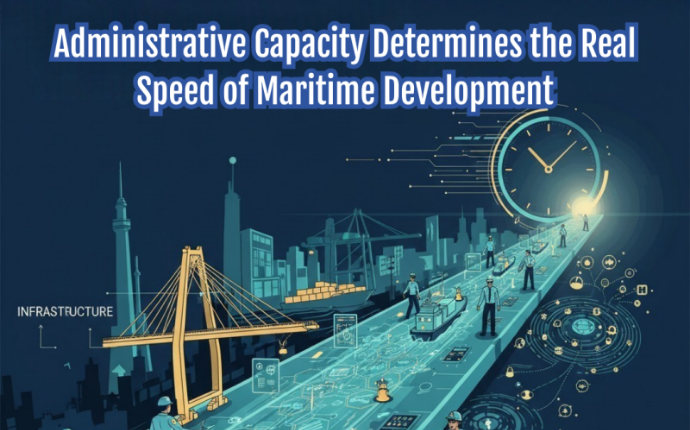
Maritime development is often measured in visible progress. New terminals are commissioned, fleets expand, trade volumes increase and global routes become more deeply integrated into national economic systems. These indicators convey momentum. They suggest movement, expansion and growth. They demonstrate that maritime activity is advancing in scale and reach.
Yet beneath this visible motion lies another determinant that shapes how quickly development can actually occur. This determinant is administrative capacity. It is the practical ability of institutions to process decisions, implement policy, coordinate responsibilities and sustain operational continuity across expanding levels of activity. While infrastructure enables movement and policy defines direction, administrative capacity determines how efficiently both can function in practice.
Administrative capacity is rarely discussed as a central element of maritime growth, yet it influences nearly every stage of development. No infrastructure project progresses without approvals, coordination and oversight. No regulatory framework functions without processes that translate rules into action. No financial assurance system operates without structured verification. No welfare mechanism delivers support without institutional execution. Development does not move at the speed of ambition. It moves at the speed of administration.
This relationship becomes increasingly significant as maritime systems expand. Growth multiplies the number of interactions that institutions must manage. More vessels require more certification and inspection. More enterprises require more regulatory engagement. Larger workforces require more extensive welfare and documentation systems. More complex financial structures require greater oversight. Each increase in activity generates corresponding administrative demand.
In smaller or earlier-stage systems, administrative structures often evolve incrementally in response to immediate needs. This gradual expansion functions effectively while activity remains proportionate to institutional capacity. Over time, however, sustained growth may produce conditions in which the scale of interaction increases faster than the administrative mechanisms designed to manage it. The result is not institutional failure, but institutional strain.
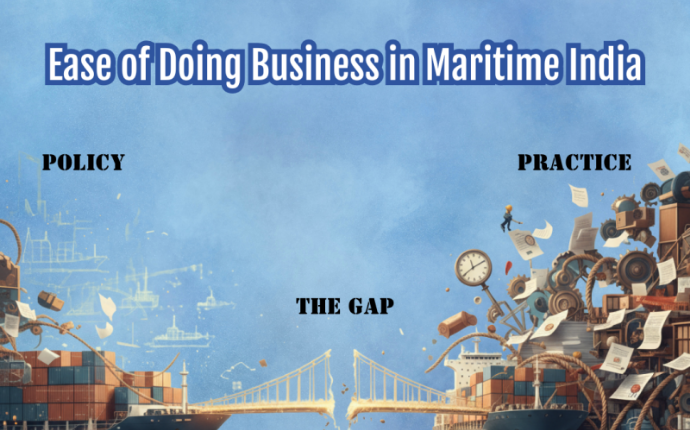
Strain does not always manifest as disruption. More often, it appears as delay, procedural layering or increased coordination effort. Administrative processes continue to function, but they require greater time or more extensive interaction to achieve outcomes that were previously achieved more directly. Development continues, yet the pace of implementation becomes influenced by the capacity of institutions to process expanding demand.
India’s maritime sector illustrates this dynamic within a context of rapid expansion and increasing global integration. The country’s growing maritime workforce, expanding regulatory responsibilities and deepening participation in international shipping networks all contribute to a rise in institutional interaction. Certification, compliance verification, financial assurance and welfare administration must operate across a scale far greater than in earlier stages of development.
Each of these functions requires structured administrative systems capable of managing complexity without loss of coherence. Administrative capacity, therefore, becomes not merely a supporting function but a structural component of maritime growth. It determines how quickly policies can be implemented, how efficiently compliance can be demonstrated and how effectively institutions can respond to evolving operational realities.
The economic implications of administrative capacity are substantial. Development projects are shaped not only by investment availability but by procedural timelines. Enterprises plan operations around expected administrative responsiveness. Workforce mobility depends on the efficiency of certification and documentation systems. Financial arrangements rely on the predictability of institutional processing. Administrative performance becomes an operational variable within the maritime economy.
Globally, maritime systems that have achieved sustained acceleration of development often demonstrate strong alignment between growth in activity and growth in administrative capability. Institutional processes are designed to scale alongside operational expansion. Information flows are structured to support efficient decision-making. Coordination mechanisms are integrated across regulatory domains. Administrative systems evolve in anticipation of increased demand rather than solely in response to it.
Such evolution reflects recognition that governance does not operate abstractly. It functions through people, processes and institutional infrastructure that must expand proportionately with the system they support. Administrative capacity, in this sense, becomes a form of institutional infrastructure parallel to physical infrastructure. It enables movement of decisions, information and responsibility just as ports enable movement of vessels and cargo.
India’s maritime ecosystem is increasingly aware of this structural relationship. As activity expands across multiple domains simultaneously, ensuring that administrative systems remain proportionate to operational scale becomes central to sustaining momentum. Governance frameworks may be well designed, and policy direction may be clear, but implementation ultimately depends on the institutional ability to act efficiently across expanding complexity.
Administrative capacity also shapes how effectively maritime systems adapt to change. Regulatory evolution, technological adoption and operational innovation all require administrative processes capable of integrating new frameworks without disrupting existing activity. Institutions that possess sufficient processing capacity can implement change smoothly. Those operating at the limits of their capacity may experience slower adaptation even when strategic direction is clear.
The Indian Maritime Federation observes the role of administrative capacity through its engagement with regulatory bodies, industry participants and workforce systems across the sector. Experience indicates that development accelerates where institutional processes function with clarity, coordination and responsiveness. Supporting dialogue that strengthens administrative coherence therefore contributes directly to sectoral growth.
Administrative capacity is not defined solely by volume of activity processed. It is defined by the quality of institutional organisation through which activity is managed. Clear procedural pathways, integrated information systems and coordinated institutional relationships enhance capacity without necessarily increasing complexity. Efficiency arises from structure rather than scale alone.
Maritime governance, by necessity, must maintain rigorous standards. Administrative capacity does not reduce this rigor. It ensures that rigor can be applied consistently across expanding activity without creating disproportionate procedural burden. It allows governance to remain effective as systems grow more complex.
As India’s maritime sector continues to expand its operational reach and institutional responsibilities, the pace of development will increasingly depend on how effectively administrative systems scale alongside physical and economic growth. Infrastructure investment and policy ambition create potential. Administrative capacity converts potential into realised progress.
Maritime systems operate across vast geographic distances, but institutional processes operate within defined procedural pathways. The efficiency of those pathways determines how quickly decisions move from intention to execution. In environments of sustained expansion, this efficiency becomes a defining feature of development.
Administrative capacity therefore functions as the hidden engine of maritime progress. It does not appear prominently in measures of fleet size or trade volume, yet it shapes the speed at which both can grow. It transforms policy into practice, regulation into operation and strategy into implementation.
In the long evolution of maritime economies, nations that align administrative capability with operational ambition often achieve more consistent and sustained development. Their systems move not only with scale but with fluidity. Growth becomes not only possible but executable.
As India’s maritime future continues to unfold, the strength of its administrative institutions will play an increasingly decisive role in determining how quickly opportunity becomes achievement. Maritime development will continue to be measured in ships, ports and trade flows. Its true pace, however, will be set by the capacity of institutions to move decisions with clarity, coherence and continuity across the expanding horizons of maritime activity.