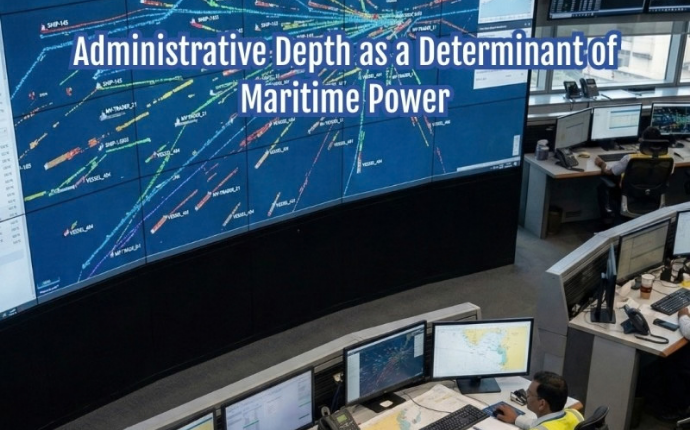
Maritime power is often understood in visible terms. The scale of a nation’s fleet, the capacity of its ports, the reach of its trade networks and the presence of its workforce across global shipping systems all contribute to how maritime strength is perceived. These elements are tangible and measurable. They reflect the operational dimension of maritime activity — the movement of goods, the deployment of vessels and the infrastructure that supports global exchange.
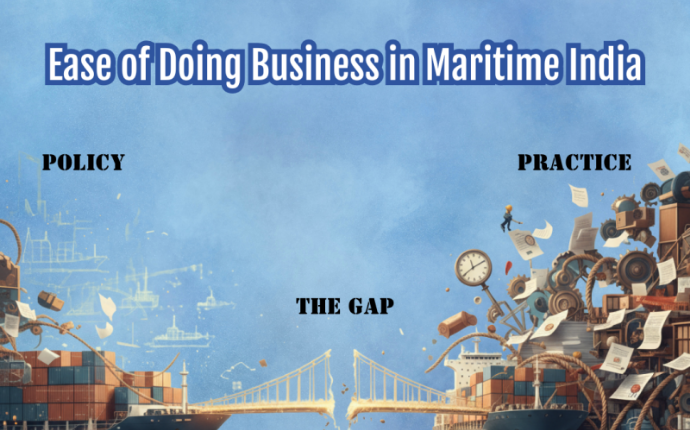
Yet beneath these visible expressions lies a quieter determinant of maritime power that shapes whether such capacity can be sustained, coordinated and extended across time. This determinant is administrative depth. It refers to the institutional capability through which governance frameworks operate with continuity, coherence and responsiveness across increasingly complex maritime environments.
Administrative depth does not attract immediate attention because it functions primarily through reliability rather than visibility. It is expressed in the consistency of regulatory processes, the clarity of institutional communication and the capacity of governance systems to manage expanding interaction without fragmentation. Where administrative depth is strong, maritime systems operate with stability even as scale and complexity grow. Where it remains limited, operational expansion may outpace institutional capacity, introducing friction that constrains long-term development.
Maritime activity presents a distinctive administrative challenge. It unfolds across jurisdictions, intersects with international regulatory frameworks and involves continuous interaction among public institutions, private enterprises and global governance bodies. The administrative systems that support such activity must therefore function across multiple layers simultaneously. They must interpret international conventions, implement domestic regulation, coordinate operational oversight and maintain institutional continuity across evolving conditions.
The depth of administrative capacity determines how effectively these functions can be sustained. Surface-level administration may establish formal structures that enable basic compliance. Administrative depth, by contrast, ensures that these structures remain capable of adaptation as maritime systems expand and transform. It reflects not merely the existence of institutions, but their ability to manage complexity without loss of coherence.
India’s maritime sector increasingly operates within an environment where such depth is essential. Economic expansion, growth in shipping participation and integration into global trade networks have multiplied the volume and diversity of administrative interaction. Certification processes, regulatory oversight, workforce coordination and international engagement all require institutional mechanisms capable of functioning across expanding operational domains.
Administrative depth manifests through several interrelated characteristics. It appears in the continuity of institutional knowledge that allows governance to remain stable across time. It appears in procedural clarity that enables participants to navigate regulatory environments without uncertainty. It appears in the capacity to coordinate across departments and jurisdictions so that maritime governance functions as an integrated system rather than as isolated administrative segments.
This depth also influences the speed and reliability with which maritime systems respond to change. Technological transformation, environmental regulation and evolving global standards require continuous institutional adaptation. Administrative systems with sufficient depth absorb such change without disruption. They integrate new requirements into existing frameworks in ways that preserve operational continuity.
Globally, maritime nations that sustain enduring influence often exhibit precisely this form of institutional capacity. Their administrative frameworks manage complex interaction while maintaining clarity. Their regulatory processes remain predictable even as they evolve. Their governance systems coordinate effectively across domestic and international domains. Such depth supports maritime power not by attracting attention, but by ensuring that visible capacity remains supported by stable institutional foundations.
India’s maritime governance continues to develop within this broader global pattern. Expansion of regulatory frameworks, alignment with international conventions and strengthening of institutional coordination all reflect recognition that maritime activity requires administrative capability equal to its operational scale. As maritime systems grow, governance must deepen correspondingly to maintain coherence.
The Indian Maritime Federation’s engagement across policy dialogue and sectoral interaction reflects awareness of this relationship between institutional depth and maritime strength. Observations across the maritime ecosystem indicate that operational capacity expands most sustainably where administrative systems provide clarity and continuity. Dialogue that supports institutional alignment contributes to the gradual strengthening of administrative depth.
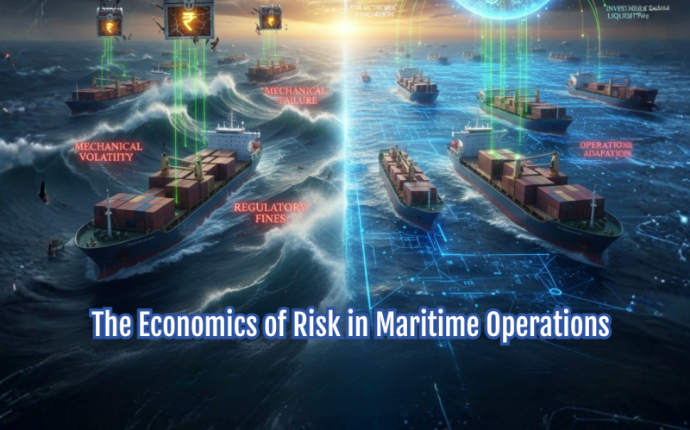
Administrative capability also shapes the economic dimension of maritime power. Investment decisions depend on the reliability of regulatory processes and the clarity of institutional interaction. Enterprises plan long-term participation where administrative frameworks operate predictably. Financial commitments align with governance environments that demonstrate consistent procedural integrity. Administrative depth therefore functions as an economic asset as well as a governance attribute.
Workforce development similarly depends on institutional capacity. Training, certification and professional recognition require administrative systems capable of sustaining continuity across extended career pathways. Seafarers whose professional credentials are supported by reliable institutional processes move more confidently across global labour markets. Administrative depth ensures that professional capability translates into recognised and sustained participation.
International engagement further amplifies the significance of administrative capacity. Maritime governance operates through networks of cooperation among national institutions and global regulatory bodies. Effective participation requires administrative systems capable of maintaining alignment with international standards while implementing domestic priorities. Depth enables institutions to engage globally without compromising internal coherence.
The temporal dimension of maritime development underscores why administrative depth is inseparable from long-term maritime power. Ships operate for decades. Infrastructure shapes economic activity across generations. Workforce participation spans entire professional lifecycles. Governance frameworks must function across these extended horizons. Administrative systems that sustain continuity across time provide the institutional stability upon which maritime expansion depends.
Maritime history offers numerous examples of how institutional depth shapes long-term outcomes. Nations that developed extensive fleets or infrastructure without corresponding administrative capacity often encountered structural strain as systems expanded beyond the ability of governance frameworks to manage them. Conversely, maritime systems supported by deep administrative capability have demonstrated the capacity to adapt across successive phases of technological and economic transformation.
India’s maritime future will continue to involve expansion across operational, economic and institutional domains. The scale of this expansion will increasingly require administrative systems capable of managing complex interaction without fragmentation. Institutional depth will determine how effectively governance supports growth while preserving stability.
Administrative depth also influences the credibility of maritime systems within global networks. International partners evaluate not only operational capacity but the reliability of institutional frameworks that sustain it. Systems characterised by clear procedures, consistent regulation and coordinated governance are recognised as stable environments for maritime participation. Credibility extends from the visible performance of administration across time.
The development of such depth is gradual. It emerges through accumulation of institutional experience, refinement of procedures and continuous alignment of governance with operational reality. Administrative systems deepen as they manage complexity repeatedly and adapt without loss of coherence. Maritime power grows in parallel because institutional capacity supports the expansion of operational capability.
In the broader architecture of maritime development, administrative depth performs a role comparable to structural reinforcement within physical infrastructure. It supports visible capacity by ensuring that underlying systems remain stable under increasing load. Without such reinforcement, expansion may appear impressive but remain vulnerable to strain. With it, maritime systems acquire durability.
As India continues to strengthen its maritime presence, the depth of its administrative capability will remain a decisive factor shaping long-term outcomes. Ships, ports and trade networks represent the visible expression of maritime power. Administrative depth represents the institutional strength that allows these expressions to endure.
In the enduring structure of maritime systems, power is sustained not solely by what moves across the sea, but by the institutional capacity that governs movement with clarity and continuity. Administrative depth, accumulated gradually and exercised consistently, becomes one of the most fundamental determinants of maritime strength.