Capital Efficiency and the Future Competitiveness of Indian Shipping
Competitiveness in maritime activity is often described through visible indicators. Fleet size, port capacity, cargo throughput, global market access and technological capability all serve as measurable expressions of strength. These are the outward dimensions through which maritime presence is recognised internationally. They reflect investment, operational scale and strategic positioning within global trade networks.
Yet beneath these visible indicators lies a quieter determinant of long-term competitiveness. It does not appear directly in fleet registries or cargo statistics, but it shapes how efficiently maritime enterprises operate, how confidently investment is pursued and how sustainably expansion can be maintained. This determinant is capital efficiency.
Capital efficiency refers to the degree to which financial resources remain productively engaged within the system rather than held in forms that restrict their movement. In capital-intensive sectors such as shipping, this distinction becomes especially significant. Maritime operations require substantial financial commitment across assets, compliance obligations, workforce support and operational continuity. The structure through which capital is organised therefore influences not only balance sheets but the entire rhythm of sectoral activity.
Historically, maritime finance has evolved around the need to secure stability in environments characterised by uncertainty. Financial structures have been designed to ensure that obligations can be fulfilled even under adverse conditions. This emphasis on assurance has produced systems in which significant portions of capital are committed to demonstrating financial readiness rather than supporting operational expansion. Such arrangements have served essential purposes, reinforcing institutional confidence and ensuring that responsibility is clearly defined.
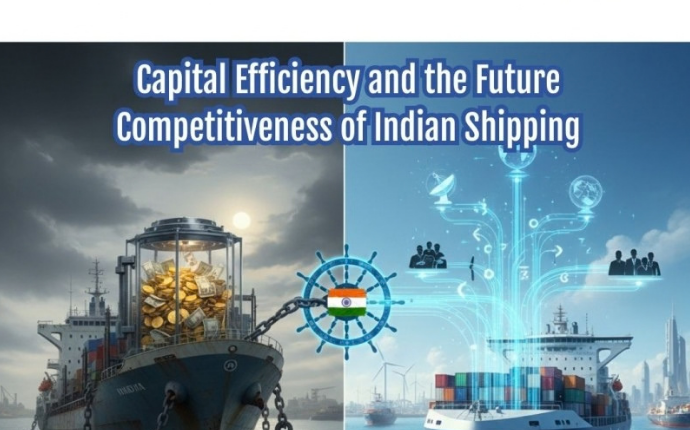
As maritime sectors expand, however, the opportunity cost of immobilised capital becomes more visible. Resources held in static forms to satisfy contingent obligations represent capacity that cannot simultaneously support investment in technology, fleet modernisation, workforce development or operational innovation. The system remains secure, yet its capacity for dynamic growth is moderated by the degree to which capital is tied to precautionary structures.
Global maritime economies that have sustained long-term competitiveness have often reached a stage where attention shifts from securing capital to mobilising it efficiently. The question becomes not simply whether financial assurance exists, but how that assurance can be structured in ways that preserve stability while allowing capital to remain active within the system. This shift does not reduce commitment to responsibility. It refines how responsibility is financially expressed.
India’s maritime sector now operates within precisely such a context. The country’s expanding global engagement, growing workforce participation and increasing institutional maturity have positioned it as an important contributor to international maritime activity. At the same time, the structure of financial commitments within the sector continues to shape how readily enterprises can respond to emerging opportunities.
Shipping, by its nature, is a sector where timing matters. Market conditions fluctuate, technological transitions accelerate and international trade patterns shift in response to economic and geopolitical change. Enterprises that can deploy capital with agility are better positioned to adapt to these shifts. Those whose financial resources remain largely immobilised in precautionary forms may find their capacity to respond constrained even when strategic opportunities are present.
Capital efficiency, therefore, becomes a structural factor influencing competitiveness. It determines how fluidly financial resources can move between assurance and investment, between protection and expansion. Systems that achieve balance between these functions maintain both stability and responsiveness. Systems that emphasise assurance without corresponding mechanisms for mobilisation may remain secure but less adaptable.
The implications extend beyond individual enterprises. Sector-wide capital efficiency influences national maritime capacity. It shapes the pace at which fleets can modernise, the scale at which domestic operators can expand and the degree to which innovation can be adopted across operational environments. Financial structures that enable productive circulation of capital support not only commercial success but institutional evolution.
India’s maritime ecosystem is characterised by diversity in scale and participation. Large operators coexist with emerging enterprises. Workforce deployment spans global markets. Regulatory frameworks support both compliance and welfare across complex conditions. Within such a landscape, the efficient use of capital becomes a collective concern. Financial arrangements that immobilise resources disproportionately may influence participation patterns, particularly among smaller operators whose capacity for precautionary allocation is more limited.
The relationship between capital structure and sectoral inclusivity is therefore significant. When financial commitments required to demonstrate responsibility are substantial and static, entry into maritime enterprise becomes more demanding. When assurance can be provided through mechanisms that distribute exposure dynamically, participation may broaden without compromising stability. Competitiveness, in this sense, is not only about scale but about the capacity of the system to support diverse forms of engagement.
Globally, maritime sectors that have addressed capital efficiency have often done so by re-examining the relationship between financial assurance and risk management. Mechanisms that transfer or distribute exposure allow capital that would otherwise remain immobilised to remain economically active. Protection is maintained, but its financial expression becomes more fluid. The system retains stability while increasing responsiveness.
India’s maritime community has increasingly recognised the importance of this balance. Discussions around sectoral development now frequently include consideration of how financial structures influence long-term competitiveness. The objective is not to reduce financial discipline but to ensure that discipline supports growth rather than constraining it unnecessarily.
The Indian Maritime Federation observes these developments through its engagement with industry participants, financial institutions and policy environments across the maritime landscape. Experience suggests that capital efficiency strengthens competitiveness when financial assurance and operational investment are aligned within coherent frameworks. Supporting dialogue around such alignment therefore becomes part of supporting the sector’s long-term vitality.
Competitiveness in modern maritime systems is shaped not only by physical and operational capability but by the financial architecture that underpins them. Fleets expand where capital can be deployed effectively. Technology is adopted where investment remains feasible. Workforce development advances where resources can be directed toward long-term stability rather than reserved solely for contingency.
As India continues to position itself within an evolving global maritime environment, the structure of capital within the sector will influence how fully its potential can be realised. Financial systems that maintain protection while enabling mobility of resources will support sustained growth. Systems in which capital remains predominantly immobilised may provide security yet limit responsiveness to emerging opportunities.
The future competitiveness of Indian shipping will therefore depend not only on investment in physical infrastructure or regulatory evolution but on how efficiently financial resources circulate within the system. Stability remains essential. Assurance remains indispensable. Yet the capacity to combine these with dynamic capital utilisation will increasingly define the sector’s ability to adapt, expand and lead within the changing landscape of global maritime activity.
In the quiet calculus of maritime economics, capital that moves productively becomes capacity. Capacity that is sustained over time becomes competitiveness. And competitiveness, when grounded in financial structures that balance protection with mobility, becomes one of the most enduring foundations upon which maritime strength is built.