Maritime activity operates within an environment where uncertainty is not an occasional disruption but a constant condition. Weather, mechanical performance, global markets, workforce mobility, geopolitical developments and regulatory evolution all interact continuously in ways that no operational design can fully control. Maritime systems do not function by eliminating uncertainty. They function by organising how uncertainty is managed.
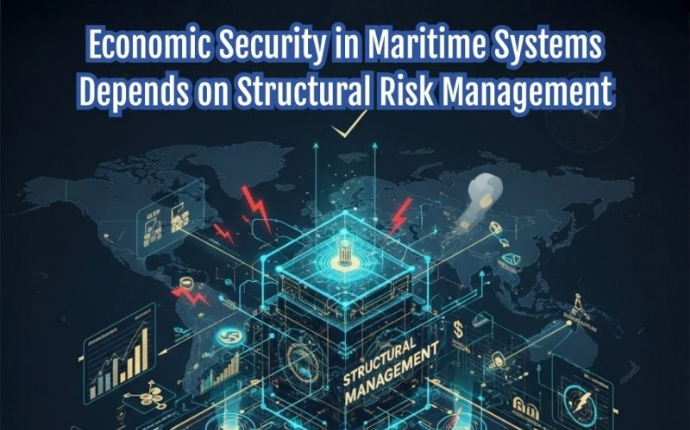
Economic security within such systems therefore cannot be understood solely as protection against isolated adverse events. It must be understood as the capacity of the entire maritime structure to absorb variability without losing continuity. This capacity depends on what may be described as structural risk management — the systematic organisation of exposure across financial, operational and institutional frameworks so that risk is distributed, anticipated and contained within predictable boundaries.
Traditional approaches to risk often focus on response. When disruption occurs, mechanisms are activated to restore stability. Compensation is paid, obligations are fulfilled and operations resume. These responses are necessary, and they form an essential part of maritime governance. Yet response alone does not constitute structural management. It addresses consequences after risk materialises but does not determine how risk is carried within the system before that moment.
Structural risk management operates differently. It integrates risk awareness into the architecture of maritime activity itself. Financial mechanisms distribute exposure across broader participation. Regulatory frameworks anticipate operational variability. Welfare systems ensure continuity of labour support across uncertain conditions. Administrative processes coordinate response pathways in advance rather than assembling them in real time. The system is designed not merely to react, but to remain stable while uncertainty unfolds.
This distinction becomes increasingly significant as maritime sectors expand. Growth multiplies the number of potential interaction points where risk may emerge. Larger fleets increase technical exposure. Expanded workforce participation increases welfare-related contingencies. Greater commercial integration introduces financial variability linked to global markets. The cumulative effect is not simply more risk, but more interconnected risk.
Interconnected risk behaves differently from isolated exposure. Disruption in one domain may influence stability in another. Financial strain may affect operational continuity. Operational disruption may influence workforce welfare. Administrative delay may shape financial liability. When risk is interconnected, economic security depends not on the strength of individual protective measures but on how effectively those measures function together as a system.
India’s maritime sector increasingly reflects this interconnected environment. The scale of maritime employment, the breadth of commercial engagement and the complexity of regulatory responsibility all contribute to a network of activity where exposure is widely distributed. Ensuring economic stability under such conditions requires frameworks capable of managing risk structurally rather than episodically.
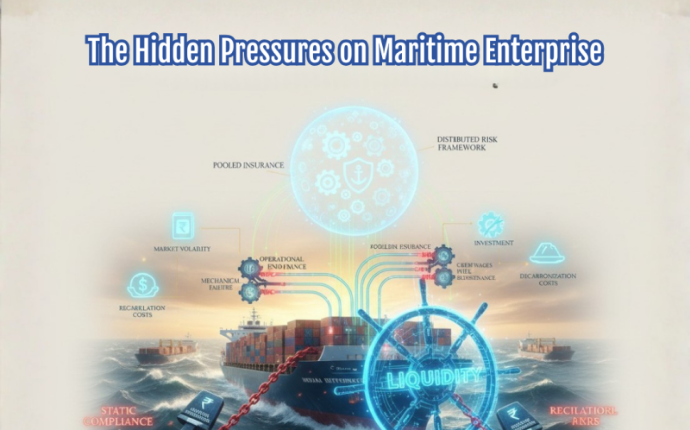
Structural risk management is not primarily about reducing risk to minimal levels. Maritime activity cannot exist without exposure. Instead, structural management seeks to prevent risk from becoming destabilising by distributing its effects across mechanisms designed to absorb variability. Financial risk may be pooled across participants. Operational risk may be mitigated through integrated safety systems. Welfare risk may be supported through continuous protection frameworks. Administrative risk may be managed through coordinated institutional response.
These mechanisms collectively form a stabilising architecture. Each component addresses a particular dimension of exposure, but their combined effect determines how resilient the system remains under strain. Economic security emerges not from the absence of risk but from the presence of structured capacity to absorb it.
Globally, maritime systems that demonstrate high levels of resilience often exhibit strong integration of structural risk management across governance domains. Financial assurance mechanisms operate in coordination with operational oversight. Labour protection frameworks interact with administrative response systems. Regulatory structures align with economic risk distribution. Stability arises because exposure is anticipated across the system rather than addressed in isolation.
India’s maritime ecosystem continues to evolve toward such integrated understanding. As participation expands across domestic and international dimensions, the need to manage risk in structural terms becomes increasingly evident. Economic security is no longer defined solely by the ability of individual enterprises to withstand disruption. It is defined by the system’s collective capacity to maintain continuity even when individual components encounter strain.
The implications extend beyond immediate operational stability. Structural risk management influences long-term investment behaviour, workforce confidence and institutional credibility. Investors engage where exposure is organised predictably. Professionals participate where welfare protection remains continuous. International partners collaborate where governance frameworks demonstrate resilience across changing conditions.
The Indian Maritime Federation observes this systemic dimension of economic security through engagement with stakeholders across regulatory, financial and operational domains. Experience indicates that maritime systems remain most stable when risk is managed through coordinated structures rather than fragmented response. Supporting dialogue around integrated risk architecture therefore contributes to the long-term durability of the sector.
Structural risk management also shapes how maritime systems adapt to transformation. Technological innovation, environmental regulation and evolving global trade patterns introduce new forms of exposure. Systems that manage risk structurally can integrate these developments without destabilisation because mechanisms for absorbing change already exist. Adaptation becomes an extension of established capacity rather than a reaction to emerging strain.
Maritime history demonstrates that economic security has rarely depended solely on individual strength. It has depended on collective arrangements that distribute uncertainty across wider participation. Early maritime ventures shared financial exposure among multiple investors. Modern shipping systems distribute risk across insurance, regulatory and welfare frameworks. The principle remains consistent even as institutional forms evolve.
India’s maritime future will involve continued expansion, increased global integration and growing operational complexity. Each of these developments will generate new forms of exposure. Ensuring that such exposure does not translate into systemic vulnerability requires governance that views risk not as isolated events but as structural conditions requiring coordinated management.
Economic security, therefore, becomes a property of system design. It reflects how financial, operational and institutional components interact to sustain continuity. Where these components function in alignment, risk becomes manageable. Where they operate independently, exposure may accumulate in ways that challenge stability.
Maritime systems operate within environments defined by constant movement and uncertainty. Structural risk management provides the framework through which this uncertainty is organised rather than resisted. It allows maritime activity to proceed with confidence that variability, though inevitable, will remain contained within mechanisms designed to absorb its impact.
As India continues to strengthen its maritime capacity, the architecture through which risk is managed will play an increasingly central role in shaping economic resilience. Ships may carry cargo across oceans, but governance carries the responsibility of ensuring that uncertainty itself is navigated with structure and foresight.
In the quiet foundations of maritime economies, structural risk management functions as one of the most essential yet least visible sources of stability. It does not eliminate uncertainty. It transforms uncertainty into a condition that can be sustained without disruption. And in doing so, it provides the economic security upon which all enduring maritime activity ultimately depends.