Across long stretches of India’s maritime journey, governance has evolved in response to necessity rather than design. Each expansion in trade, each surge in workforce mobility, each technological shift at sea has brought with it new responsibilities that required supervision, coordination and oversight. Regulation, in this sense, has never been an abstract administrative function. It has been a practical response to complexity. It has been the mechanism through which safety was protected, standards were upheld, and credibility was preserved in an industry where consequences travel far beyond national waters. Yet as maritime activity deepens and diversifies, a quiet but important shift is becoming visible. The question is no longer whether governance must exist, but how it must now evolve to remain effective in a system that has grown in scale, speed and interconnectedness.
India’s maritime ecosystem today operates within a landscape that is far more layered than the one that shaped many of its foundational regulatory structures. The country’s seafarers serve on vessels across multiple jurisdictions. Indian operators navigate international commercial cycles while remaining anchored to domestic compliance expectations. Training institutions prepare professionals for a labour market that is both global and highly standardised. Financial institutions, insurers, regulators and welfare bodies operate within overlapping spheres of responsibility that must remain aligned even as their individual mandates expand. In such an environment, governance cannot remain static without gradually becoming strained by the very activity it is meant to support. The question is not whether existing frameworks have served their purpose, but whether they can continue to do so without refinement as the system they oversee grows more intricate.
What becomes apparent when one observes this landscape closely is that regulatory systems do not experience pressure all at once. They accumulate it gradually. Each additional requirement, each procedural safeguard, each verification mechanism is introduced with legitimate intent. Over time, however, the accumulation itself becomes a structural feature. Oversight grows denser. Processes grow more layered. Responsibility grows more concentrated within institutional centres that must monitor increasingly complex interactions. None of this is inherently problematic. Indeed, such layering often reflects diligence and care. But when the environment being governed expands faster than the architecture designed to supervise it, enforcement alone cannot sustain equilibrium. A system that relies primarily on monitoring and intervention must continuously expand its capacity simply to maintain its existing level of effectiveness.
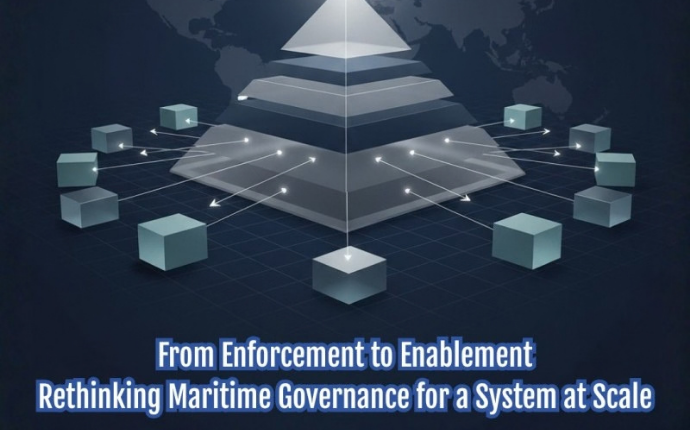
This dynamic is not unique to maritime administration. It is characteristic of every sector that transitions from moderate scale to systemic significance. When activity multiplies, governance must eventually shift from reactive supervision to structured enablement. The difference between the two is subtle but profound. Enforcement focuses on ensuring compliance with established requirements. Enablement focuses on designing systems in which compliance becomes embedded within operational reality. One supervises behaviour from outside. The other shapes behaviour from within. Both are necessary at different stages of institutional development, but they perform different functions. When a sector matures, the balance between them naturally shifts.
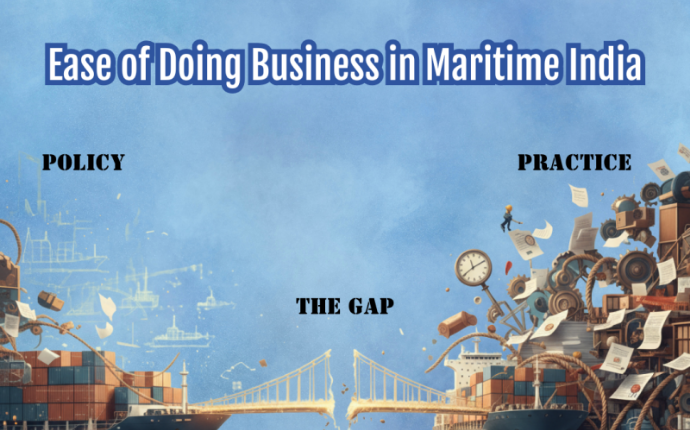
Within India’s maritime environment, the lived experience of operators, seafarers, regulators and administrators increasingly reflects the tension between scale and structure. Procedures that once functioned smoothly now encounter volume that tests their limits. Verification systems designed for manageable throughput now face sustained pressure from expanding activity. Financial safeguards that were introduced to ensure responsibility sometimes generate unintended constraints on operational flexibility. Welfare mechanisms designed to provide assurance must coordinate across multiple administrative channels before delivering outcomes. Each of these developments is understandable when viewed individually. Taken together, however, they reveal a pattern that is structural rather than incidental. The system is not malfunctioning. It is simply carrying more weight than its original design anticipated.
For those working within this environment, the consequences are experienced not as dramatic breakdowns but as incremental friction. Decisions require more steps than before. Coordination requires more time. Oversight requires more attention. Administrative effort rises steadily, often without any visible change in policy intent. What emerges is a governance landscape that remains committed to its objectives but must expend increasing energy to sustain alignment across expanding operational realities. This is precisely the point at which mature sectors begin to reconsider not their regulatory commitment, but their regulatory architecture.
The relationship between governance and growth has always been reciprocal. Regulation creates the conditions for trust, and trust allows economic and professional activity to expand. But as expansion accelerates, governance must also ensure that the structures through which it operates remain proportionate to the environment they shape. When systems become sufficiently complex, their stability depends less on the intensity of supervision and more on the design of the frameworks through which responsibility is distributed, monitored and fulfilled. Effective governance at scale is not characterised by constant intervention. It is characterised by institutional arrangements that reduce the need for intervention by making compliance structurally embedded.
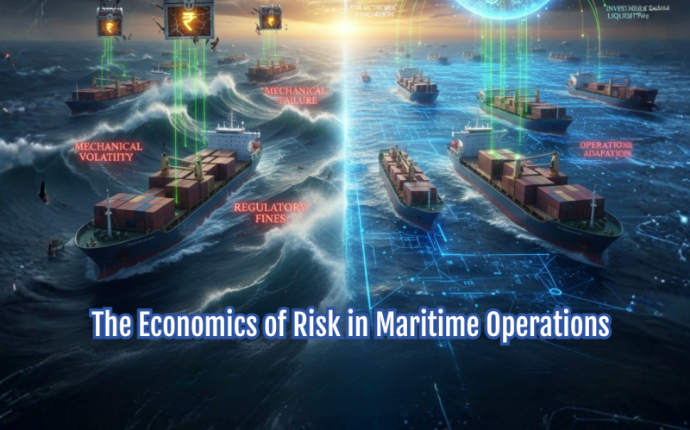
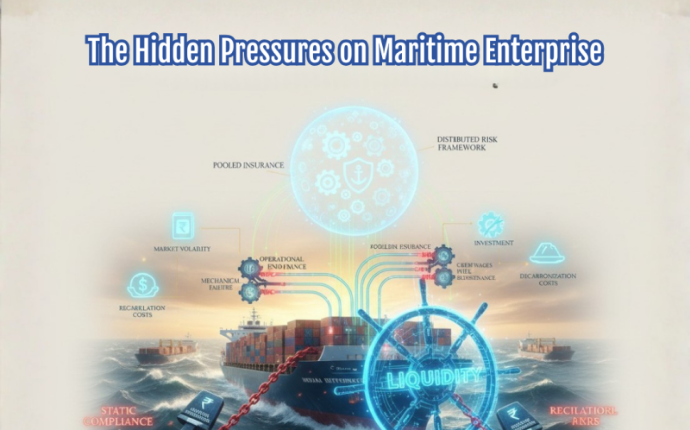
Globally, maritime sectors that have undergone similar transitions reveal a consistent pattern. As workforce mobility expands, welfare systems move toward collective assurance models that function predictably regardless of individual circumstances. As operational networks become more interconnected, financial safeguards evolve into risk-sharing structures that distribute exposure rather than concentrating it. As regulatory oversight becomes more demanding, verification systems shift toward integrated processes that reduce administrative repetition while maintaining transparency. These developments do not represent a relaxation of standards. They represent an evolution in how standards are sustained.
India’s maritime governance framework stands at precisely this threshold of institutional maturity. The scale of its workforce, the reach of its commercial activity and the complexity of its regulatory responsibilities place it firmly within the category of systems that must now refine structure in order to sustain effectiveness. The transition from enforcement-centred administration to enablement-oriented governance is not a departure from regulatory commitment. It is its continuation under new conditions. It reflects recognition that enduring compliance is best achieved when systems are designed to support it continuously rather than verify it repeatedly.
Such transitions require careful reflection because they involve more than procedural adjustment. They involve re-examining how responsibility is organised across institutions, how assurance mechanisms are structured, and how regulatory objectives are translated into operational design. They require acknowledging that systems which once functioned efficiently under earlier conditions may require redesign not because they were inadequate, but because they succeeded in fostering growth that now exceeds their original scope. Institutional evolution of this kind is neither abrupt nor disruptive. It is deliberate, incremental and guided by the same principles that shaped earlier regulatory development: safety, credibility, fairness and resilience.
Within the broader maritime ecosystem, there is increasing recognition that governance capacity is strengthened when institutional design evolves alongside operational expansion. The conversation is gradually shifting from how compliance is enforced to how compliance is sustained. This shift reflects confidence rather than concern. It signals that the sector has reached a level of maturity where refinement of structure becomes both possible and necessary. It also reflects an understanding that regulatory institutions are most effective when they are not required to expand indefinitely simply to keep pace with activity. Their strength lies in shaping systems that remain stable even as the environment around them continues to grow.
In this evolving context, the role of institutional dialogue becomes especially significant. The interaction between regulators, industry participants, welfare bodies and policy planners is no longer limited to interpreting rules. It increasingly involves examining how governance itself can be structured to function more fluidly under conditions of scale. Such dialogue does not seek to diminish regulatory authority. It seeks to enhance its effectiveness by ensuring that the frameworks through which authority operates remain aligned with contemporary realities. The objective is continuity of protection, continuity of accountability and continuity of trust, achieved through systems that are designed for endurance rather than adjustment.
The Indian Maritime Federation, through its engagement across multiple segments of the sector, observes this moment of transition with a sense of constructive attentiveness. The evolving scale of maritime activity, the expanding expectations placed upon regulatory institutions and the growing interdependence between operational and welfare systems all point toward a shared opportunity for institutional strengthening. The emphasis is not on replacing existing governance principles, but on ensuring that the mechanisms through which they operate remain proportionate, responsive and structurally coherent. The Federation’s continuing engagement reflects a commitment to supporting dialogue that is grounded in experience, informed by comparative understanding and oriented toward long-term stability.
As India’s maritime sector continues to expand its global presence, governance will remain one of its defining strengths. The credibility of its workforce, the reliability of its operators and the confidence of its international partners all depend upon institutional frameworks that function predictably under pressure and adapt thoughtfully over time. The transition from enforcement toward enablement does not mark a departure from regulatory vigilance. It marks the natural progression of a system that has grown sufficiently robust to consider how its internal architecture can evolve alongside its expanding responsibilities.
Every mature maritime nation eventually reaches a stage where governance is no longer measured solely by the capacity to supervise, but by the capacity to sustain alignment across complex, interconnected activity. India’s maritime ecosystem is approaching that stage with clarity and deliberation. The process of refinement that now unfolds will not be defined by urgency but by careful consideration of how systems can be designed to endure. Governance, in its most enduring form, is not the constant exertion of control but the quiet assurance that structures are capable of supporting responsibility wherever and whenever it arises. In that assurance lies the foundation upon which the next phase of India’s maritime journey will continue to unfold.
#MaritimeGovernance #MaritimePolicy #GlobalShipping