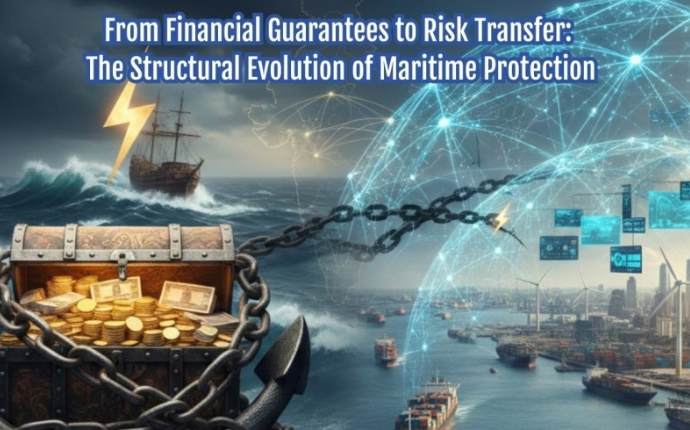
From Financial Guarantees to Risk Transfer: The Structural Evolution of Maritime Protection
Every institutional system develops instruments that reflect the conditions under which it was originally formed. These instruments are rarely accidental. They emerge from specific needs, respond to particular risks and serve clearly defined purposes at the time of their creation. Over time, however, the environment in which they operate evolves. Activity expands, relationships become more interconnected and exposure assumes new forms. When this happens, the instruments that once provided stability begin to function within a context far more complex than the one for which they were designed.
Maritime governance offers a clear illustration of this pattern. As shipping activity grew in scale and international integration deepened, regulatory systems required mechanisms that could demonstrate responsibility with certainty. Financial guarantees emerged as one of the most direct ways to provide such assurance. They signalled that obligations would be met if circumstances required intervention. They provided visible confirmation that operators possessed the financial standing necessary to support compliance and accountability. In an environment where trust needed tangible expression, guarantees performed an essential stabilising function.
At their core, financial guarantees represent a form of contingent assurance. They exist to confirm that resources are available should defined conditions arise. Their strength lies in their clarity. They establish responsibility in advance, reduce uncertainty regarding financial capacity and reinforce institutional confidence that obligations will not remain unmet. In sectors where safety, welfare and public interest must be protected across complex operational environments, such certainty has long been considered indispensable.
Yet certainty of obligation is not identical to continuity of protection. A guarantee confirms that a financial response will occur when triggered, but it does not itself manage the ongoing exposure that produces the need for response. It secures the aftermath of risk rather than shaping how risk is carried throughout the system. As maritime sectors expand and risk becomes increasingly distributed across interconnected networks, this distinction becomes more pronounced.
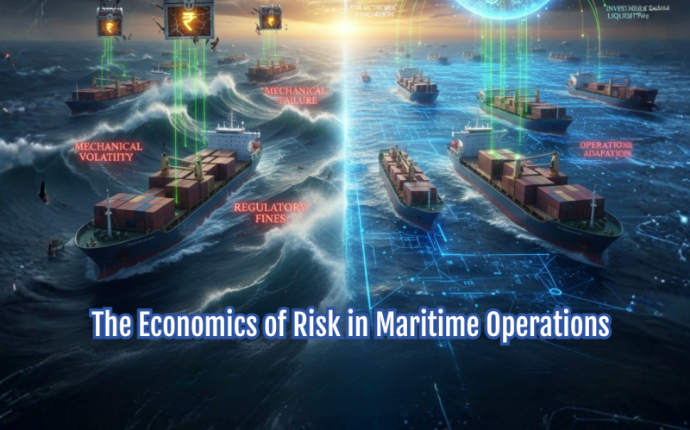
Risk, in contemporary maritime environments, does not behave as a series of isolated contingencies. It emerges continuously from operational complexity, global market interaction, workforce mobility and technological interdependence. Mechanical failure, labour-related disruption, financial instability and environmental exposure are no longer exceptional events. They are persistent possibilities embedded within daily operations. Systems that rely solely on contingent financial assurance address the consequences of risk when it materialises. They do not alter the structural conditions through which risk accumulates or propagates.
This reality has gradually given rise to a different conceptual approach within mature maritime economies. Rather than securing individual obligations through static financial commitments alone, institutions have begun to emphasise risk transfer as an ongoing structural process. Risk transfer does not eliminate exposure. It redistributes it continuously across mechanisms designed to absorb variability as part of normal system functioning.
The difference between guarantee and transfer is subtle in appearance but profound in operation. A guarantee stands in reserve, activated when defined events occur. Risk transfer operates continuously, ensuring that exposure is carried collectively before adverse events materialise. One secures responsibility after risk crystallises. The other manages risk as it unfolds.
In economic terms, this transition reflects a broader shift from assurance of solvency to assurance of resilience. Solvency ensures that obligations can be fulfilled after disruption. Resilience ensures that disruption can be absorbed without destabilising the system that must fulfil those obligations. As maritime sectors grow in complexity and scale, resilience becomes as important as solvency because the stability of the system itself becomes a central concern.
India’s maritime sector now operates within an environment where this distinction carries increasing practical relevance. The scale of maritime employment, the breadth of international engagement and the interdependence of regulatory, financial and welfare systems all contribute to an ecosystem in which exposure is systemic rather than isolated. Financial commitments that demonstrate responsibility remain essential. Yet the capacity to distribute and absorb risk continuously has become equally important in sustaining operational stability.
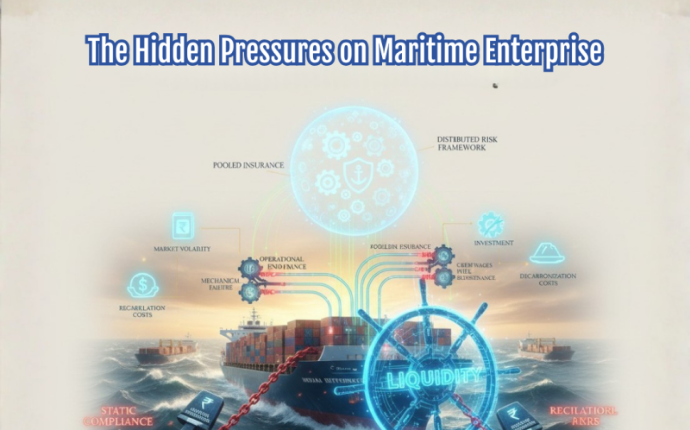
Static financial guarantees, by their nature, concentrate capital within instruments that remain largely inactive until specific triggers occur. They provide certainty, but they also immobilise resources that might otherwise support dynamic risk management. As exposure expands across multiple domains simultaneously, the economic cost of immobilised capital becomes more visible. Enterprises must maintain substantial reserves to satisfy contingent obligations even when those reserves could otherwise strengthen operational resilience if deployed differently.
Risk transfer mechanisms operate according to a different logic. Rather than holding capital in reserve against potential loss, they organise exposure across structured frameworks that distribute financial responsibility across broader participation. Loss, when it occurs, is absorbed through mechanisms designed to function continuously rather than activated episodically. Financial capacity remains active within the system rather than held apart from it.
The implications of this distinction extend beyond financial efficiency. They influence how quickly support can be mobilised, how predictably welfare can be delivered and how smoothly regulatory objectives can be fulfilled under changing conditions. When risk is transferred continuously, response becomes integrated into system behaviour. When risk is secured contingently, response depends on procedural activation that may introduce delay even when responsibility is clear.
Globally, maritime systems that have embraced structured risk transfer have often done so gradually, building upon existing guarantee frameworks rather than replacing them abruptly. Financial assurance remains present, but its role evolves. Guarantees continue to provide foundational security, while risk transfer mechanisms operate alongside them to manage ongoing exposure. The result is layered protection in which responsibility is demonstrated and resilience is sustained simultaneously.
Such layered architecture reflects an important institutional insight. Stability in complex systems depends not only on the ability to meet obligations after disruption but on the ability to maintain continuity while disruption is unfolding. Maritime activity, characterised by continuous exposure to variability, requires protection that functions throughout the cycle of risk rather than at its endpoint alone.
India’s maritime ecosystem now stands within a phase of development where such structural evolution becomes increasingly relevant. Continued expansion in operational scale, workforce deployment and regulatory complexity introduces exposure that cannot be stabilised solely through instruments designed for earlier conditions. Financial assurance must interact with mechanisms capable of distributing risk across the system in real time.
This interaction does not represent a departure from established governance principles. It represents their extension. The commitment to responsibility remains unchanged. What evolves is the method through which responsibility is operationalised within an environment of continuous uncertainty. Risk transfer allows responsibility to be expressed not only through financial readiness but through structural capacity to absorb variability without disruption.
Within the maritime community, recognition of this evolution is emerging gradually as stakeholders observe how financial, operational and welfare systems interact under conditions of expansion. Dialogue increasingly reflects interest in frameworks that combine certainty of obligation with continuity of protection. The objective is not to replace existing safeguards but to align them with mechanisms capable of sustaining stability across increasingly interconnected activity.
The Indian Maritime Federation engages with these developments through its ongoing observation of how financial assurance structures influence system resilience. Experience across the sector suggests that stability is strengthened when exposure is managed through arrangements that distribute risk proportionately rather than concentrate it contingently. Supporting dialogue around structural evolution therefore becomes part of supporting the long-term coherence of maritime governance.
As India’s maritime sector continues to deepen its global engagement, the distinction between guaranteeing responsibility and transferring risk will shape how effectively stability is maintained across expanding activity. Systems that rely exclusively on contingent assurance may remain secure yet increasingly constrained. Systems that incorporate continuous risk distribution gain flexibility without sacrificing accountability.
The evolution from guarantee to transfer is not abrupt. It unfolds as institutions recognise that exposure itself has changed character. When risk becomes systemic, protection must become systemic as well. Financial assurance remains the foundation upon which confidence rests. Risk transfer becomes the mechanism through which confidence is sustained under conditions that change constantly.
Maritime history has always been shaped by adaptation to the realities of the sea. Instruments that once provided sufficient protection have evolved as voyages grew longer, vessels larger and trade networks more complex. Today’s environment represents another stage in that progression. The movement from static financial assurance toward dynamic risk distribution reflects the natural maturation of systems that have grown beyond the conditions for which earlier instruments were designed.
Protection in maritime systems has never been defined solely by the presence of resources. It has been defined by how effectively those resources sustain continuity across uncertainty. As India’s maritime future continues to unfold, the structural evolution from financial guarantees toward integrated risk transfer will quietly shape the stability upon which that future depends.