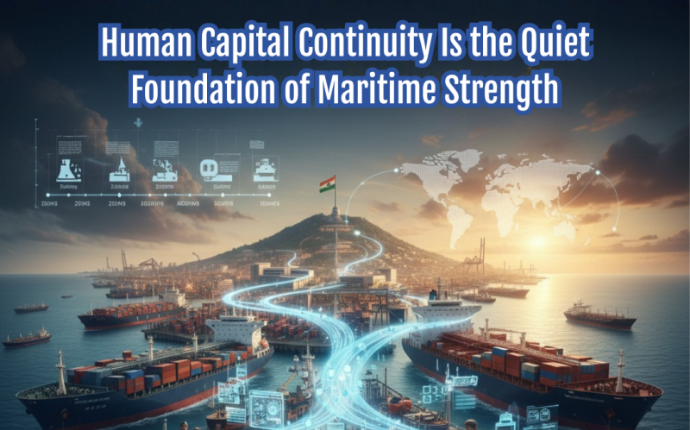
Maritime systems are often described in terms of infrastructure, fleets and trade networks. These visible elements convey scale and capacity. They demonstrate the physical reach of maritime activity and the economic flows it supports. Yet beneath these material indicators lies a more enduring foundation — the continuity of human capability that sustains the system across time.
Human capital continuity refers to the stable development, retention and progression of the people whose knowledge, skill and experience make maritime activity possible. Ships require trained professionals to operate safely. Regulatory systems depend on institutional expertise to function coherently. Technical standards rely on accumulated knowledge to remain effective. Commercial relationships are sustained through professional competence and reliability. Maritime systems function because people carry institutional memory forward from one generation of activity to the next.
This continuity is rarely measured directly, yet it shapes every dimension of maritime strength. Infrastructure may be constructed through investment, but its operation depends on trained personnel. Regulatory frameworks may be designed through policy, but their implementation depends on professional judgement. Financial systems may secure accountability, but their administration depends on institutional expertise. Human capital provides the living continuity through which maritime systems endure.
Maritime professions are distinctive in their temporal structure. Training pathways require sustained preparation. Professional advancement often unfolds across decades of experience. Skills are refined through exposure to varied operational environments. Knowledge accumulates gradually, shaped by both formal learning and practical engagement. The maritime workforce therefore represents not only present capability but a continuous transmission of expertise across time.
Continuity within such a workforce depends on more than recruitment. It depends on stable institutional environments that support professional development, recognition and welfare throughout the lifecycle of maritime careers. Individuals invest in skill formation with the expectation that their expertise will remain valued and transferable across evolving conditions. Systems that sustain this expectation cultivate enduring professional engagement.
India’s maritime sector illustrates the significance of this continuity with particular clarity. The country’s seafaring workforce serves across global fleets, contributing to international shipping operations that depend on consistent professional standards. Domestic maritime enterprises rely on technical and managerial expertise developed through long-term institutional engagement. Regulatory and administrative frameworks operate through professionals whose experience sustains institutional knowledge.
As maritime activity expands, the importance of maintaining continuity across this human capital becomes increasingly pronounced. Growth introduces new technologies, evolving regulatory expectations and changing operational environments. Integrating these developments requires professionals capable not only of adaptation but of transmitting knowledge across generations of practice. Systems that maintain such transmission preserve stability while evolving.
Human capital continuity is not simply a function of workforce size. It reflects the depth and durability of professional pathways. It depends on training systems aligned with future requirements, certification frameworks that maintain international recognition and welfare structures that support individuals across varied operational contexts. Each of these institutional elements contributes to sustaining the flow of expertise across time.
Discontinuity in human capital does not necessarily produce immediate operational disruption. Maritime systems possess inherent resilience. Yet over extended periods, erosion of professional continuity can influence institutional memory, technical competence and the capacity to integrate change. Experience that is not transmitted becomes knowledge that must be relearned. Systems that rely on accumulated expertise may require greater effort to maintain stability.
Globally, maritime economies that sustain long-term strength often demonstrate deliberate attention to the continuity of their professional base. Training institutions maintain alignment with evolving industry standards. Career pathways remain structured and recognisable. Welfare frameworks support long-term engagement rather than short-term participation. Institutional knowledge is preserved through stable professional communities.
India’s maritime ecosystem increasingly reflects awareness of these dynamics. As the sector deepens its global integration and expands domestic capacity, ensuring continuity of expertise becomes central to sustaining growth. Professional development is not merely a labour market function. It is a strategic component of maritime capability.
The Indian Maritime Federation observes this dimension of sectoral strength through engagement with workforce development, industry participation and regulatory institutions. Experience indicates that maritime systems maintain stability most effectively when professional pathways remain continuous and well supported. Dialogue that strengthens alignment between training, certification and welfare contributes directly to institutional resilience.
Human capital continuity also shapes how maritime systems respond to transformation. Technological innovation, environmental regulation and evolving operational models require adaptation of skill sets. Systems that possess stable professional foundations integrate such change more effectively because expertise evolves rather than being replaced. Learning occurs within established institutional memory rather than through repeated reconstruction.
The global nature of maritime labour further reinforces the importance of continuity. Professionals operate across jurisdictions where recognition of certification and competence depends on consistent standards. Systems that maintain stable professional frameworks enhance mobility while preserving institutional coherence. Human capital becomes both nationally rooted and internationally connected.
India’s maritime workforce already functions within this dual context. Its professionals contribute globally while remaining linked to domestic training and certification structures. Sustaining this connection requires institutional environments that support professional continuity across both national and international dimensions. Governance, therefore, plays a central role in maintaining alignment between global participation and domestic capacity.
Human capital continuity also carries broader economic implications. Maritime activity supports extensive networks of employment, education and regional development. Stable professional pathways contribute to social mobility and long-term economic participation. Workforce continuity strengthens not only operational capability but societal engagement with maritime activity as a viable and respected field of endeavour.
Maritime systems operate across long cycles of investment, infrastructure development and institutional evolution. Human capital continuity ensures that knowledge and expertise persist across these cycles. It allows maritime activity to retain coherence even as physical and regulatory environments change. People carry forward the accumulated experience through which systems remain functional.
In the long history of maritime development, the most enduring maritime economies have been those that sustained not only ships and trade but the professional communities that operate them. Knowledge transmitted across generations becomes an institutional asset as valuable as any physical infrastructure.
As India’s maritime future continues to expand across global and domestic horizons, the continuity of its human capital will remain one of the most fundamental determinants of sustained strength. Ships may represent mobility, infrastructure may represent capacity and policy may represent direction. Human capital represents continuity — the enduring presence of expertise that allows all other elements to function with coherence across time.
In the quiet architecture of maritime systems, continuity of professional knowledge forms the foundation upon which stability, adaptability and long-term capability rest. It is not always visible in statistics or infrastructure. Yet without it, no maritime system can sustain its strength across generations.