In most sectors of economic activity, insurance is understood as a financial instrument that responds to uncertainty. It exists in the background, activated when events disrupt the expected course of operations. It compensates for loss, restores continuity and distributes financial impact across a broader base than any individual actor could sustain alone. Its function is stabilising, but its presence is often regarded as auxiliary—important, yet separate from the structural foundations of the system itself.
Maritime activity presents a different reality. Here, uncertainty is not episodic. It is embedded within the operating environment. Distance, exposure, mechanical complexity, human endurance and fluctuating global markets interact continuously in ways that no operational design can fully eliminate. In such an environment, the mechanisms that absorb uncertainty do not merely support the system from the outside. They become part of how the system remains functional at all times. Insurance, in this sense, does more than respond to disruption. It enables continuity in the presence of permanent risk.
Historically, maritime enterprise has been one of the earliest domains in which structured risk-sharing emerged as a necessity rather than a convenience. Long before modern regulatory frameworks existed, maritime ventures required collective arrangements to distribute exposure that no single merchant or vessel owner could bear independently. The logic was straightforward. The sea carries uncertainty that cannot be contained within individual boundaries. Stability therefore requires shared protection. Over time, this principle evolved into formal insurance structures that became deeply embedded within the architecture of global shipping.
Today, maritime insurance operates across multiple layers of activity. It protects physical assets, financial obligations and human welfare. It supports commercial confidence by ensuring that losses do not propagate uncontrollably through interconnected systems. It provides assurance to regulators that responsibilities can be fulfilled even when adverse events occur. It sustains trust among international partners who depend on predictable mechanisms of financial response. Insurance, therefore, performs a function that extends beyond compensation. It stabilises relationships across the maritime ecosystem.
India’s maritime sector operates within this long tradition while also navigating the evolving realities of a rapidly expanding economic environment. The scale of maritime engagement has increased significantly. Workforce participation has expanded across global markets. Regulatory expectations have become more complex. Financial commitments have grown alongside operational sophistication. These developments have reinforced the importance of risk management structures that can support continuity across a widening range of exposures.
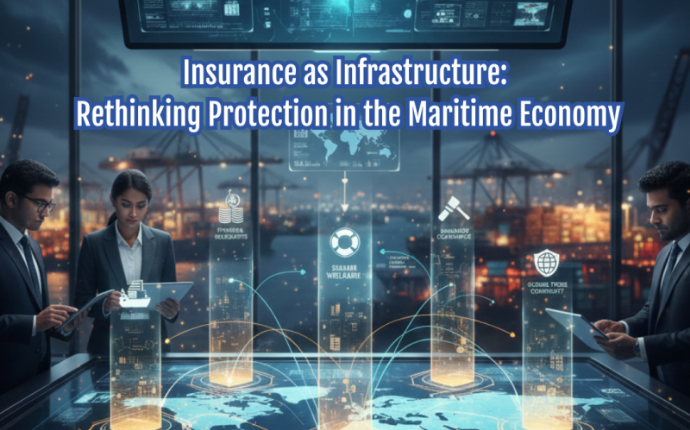
Within this context, insurance begins to assume a character that resembles infrastructure more than financial contingency. It forms part of the structural environment that allows maritime activity to proceed with confidence. Just as physical infrastructure supports movement across space, insurance infrastructure supports stability across uncertainty. It enables operators to engage in complex activity without carrying risk in forms that would otherwise constrain participation. It allows institutions to define responsibilities with the assurance that mechanisms exist to fulfil them even under strain.
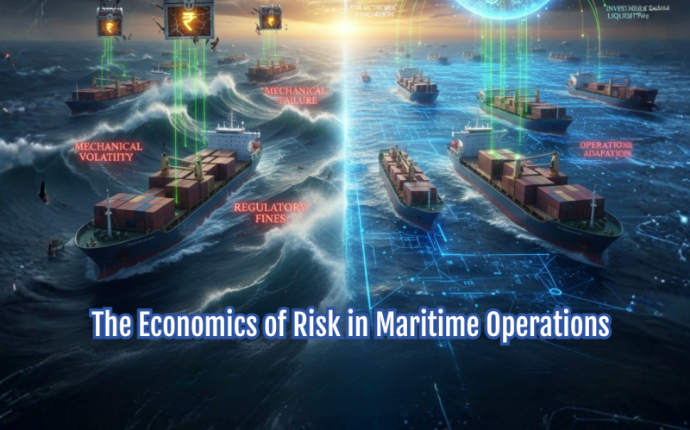
This infrastructural role becomes particularly visible when examining the relationship between risk, capital and operational continuity. Maritime enterprises must commit significant financial resources to sustain compliance, maintain assets and support workforce deployment. Without mechanisms that distribute exposure, each adverse event would require direct absorption by individual actors, placing strain on liquidity and limiting long-term resilience. Insurance transforms unpredictable loss into structured financial expectation. It converts uncertainty into manageable risk. In doing so, it allows capital to remain productive rather than immobilised by precaution.
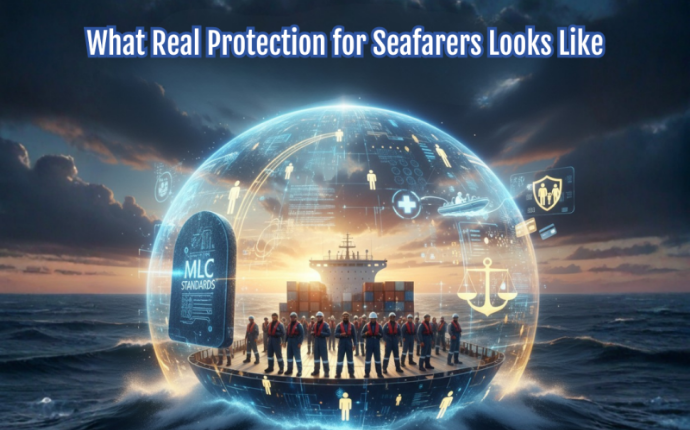
The relationship between insurance and welfare is equally significant. Seafarers operate within environments where institutional support cannot always be physically present. When adverse events occur—whether related to health, safety or employment stability—the effectiveness of protection depends on the speed and reliability of financial response. Insurance structures that function predictably ensure that support does not depend solely on administrative sequencing or discretionary action. They provide continuity of protection that travels with the individual regardless of location.
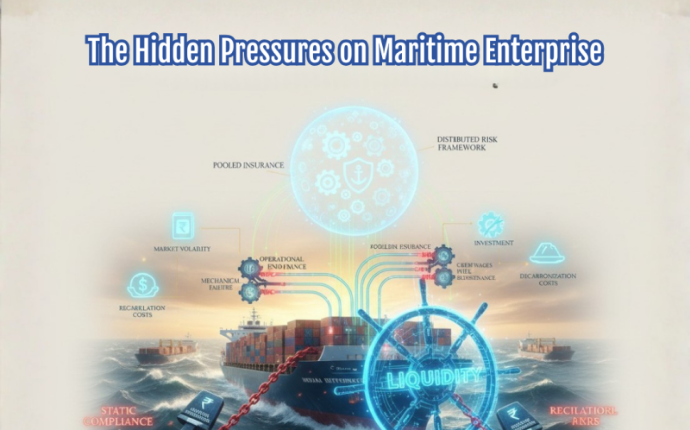
As maritime systems grow in scale, the role of insurance becomes increasingly systemic. Risk is no longer confined to isolated incidents affecting individual operations. It becomes distributed across networks of activity that interact continuously. Mechanical failure, financial disruption or labour-related events can influence multiple actors simultaneously. Insurance structures capable of pooling exposure across broader participation allow the system to absorb such events without destabilising its overall functioning.
Globally, this understanding has led to the development of increasingly sophisticated insurance architectures that operate in close alignment with regulatory and operational frameworks. Risk assessment is integrated with compliance verification. Financial assurance mechanisms interact with welfare protection. Data flows across institutional boundaries to support coordinated response. Insurance is not positioned outside governance. It operates within governance as one of the mechanisms through which stability is sustained.
India’s maritime ecosystem now moves within a phase of development where the structural role of insurance invites renewed attention. The sector’s continued expansion brings with it increasing exposure across operational, financial and human dimensions. Managing this exposure effectively requires not only the presence of insurance instruments but the alignment of those instruments with the broader architecture of maritime governance.
Alignment, in this context, means more than availability of coverage. It involves coherence between how risk is generated, how it is assessed and how it is absorbed. Financial assurance requirements, welfare protection mechanisms and operational risk management must function within frameworks that complement one another. Where insurance operates independently of these frameworks, response may remain technically available yet procedurally distant. Where insurance is structurally integrated, response becomes an inherent feature of system design.
The movement toward integrated insurance architecture reflects recognition that protection must function continuously rather than episodically. Maritime activity does not pause while risk is evaluated. Operations proceed across conditions that change without warning. Protection must therefore remain active within the system rather than waiting to be activated from outside it. Insurance, when positioned as infrastructure, provides precisely this form of continuous readiness.
Within India’s maritime community, awareness of this structural dimension of insurance has been growing alongside broader discussions of governance evolution and system integration. Stakeholders increasingly recognise that financial protection mechanisms influence not only how loss is absorbed but how confidently activity is undertaken. When risk is distributed through stable and predictable structures, participation expands because uncertainty becomes manageable rather than prohibitive.
The Indian Maritime Federation observes these developments through its engagement with industry participants, financial institutions and regulatory bodies across the maritime landscape. Experience suggests that the long-term resilience of maritime systems depends on how effectively risk-sharing mechanisms are embedded within the institutional frameworks that govern activity. Supporting such embedding involves dialogue that examines how insurance can function not merely as financial contingency but as structural assurance.
This perspective does not alter the fundamental purpose of insurance. It expands its functional significance. Protection becomes more than response. It becomes a condition of sustained operation. Financial stability becomes not only a safeguard against disruption but an enabling environment for growth. Welfare assurance becomes not only a regulatory obligation but a continuous institutional capability.
As India’s maritime sector continues to deepen its global engagement, the structural integration of insurance will play an increasingly important role in shaping its trajectory. Systems that distribute risk effectively can expand without carrying proportionate vulnerability. Institutions that align financial protection with operational reality can respond to uncertainty without procedural delay. Workforce confidence strengthens when assurance travels with individuals across changing circumstances.
In the broader history of maritime development, the evolution of insurance has always followed the expansion of activity. As voyages grew longer, vessels larger and trade networks more complex, risk-sharing mechanisms became more sophisticated. The present moment represents another stage in that ongoing evolution. Maritime activity now operates at scales that require protection to function as an integrated structural element rather than a supplementary instrument.
Infrastructure is often defined by what allows movement to occur without interruption. In maritime systems, physical infrastructure supports the movement of ships and goods. Insurance infrastructure supports the continuity of participation itself. It allows enterprises to engage, institutions to govern and individuals to work within environments where uncertainty remains ever present but no longer destabilising.
As India’s maritime journey continues to unfold, the recognition of insurance as infrastructure reflects a broader understanding of what sustains complex systems over time. Stability does not arise solely from physical capacity or regulatory authority. It arises from the presence of mechanisms that absorb uncertainty while allowing activity to proceed with confidence. Within that quiet absorption lies one of the most enduring foundations of maritime resilience.