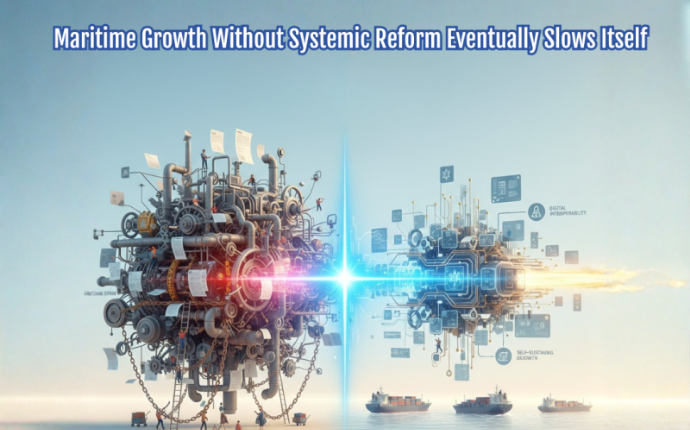
Growth is often understood as an unmistakable sign of vitality. When a sector expands in scale, reach and influence, it signals capability, demand and forward movement. In maritime activity, growth is visible in many forms—rising cargo volumes, expanding fleets, increasing workforce participation, strengthening global engagement and the steady deepening of institutional responsibility. Each of these indicators reflects progress. Together, they convey the image of a system in motion, responding to opportunity and adapting to changing economic realities.
Yet growth, particularly when sustained over time, alters the environment in which it occurs. The structures that support expanding activity are not passive. They experience pressure, adjustment and gradual transformation as scale increases. Systems designed to function effectively under one set of conditions must adapt when those conditions evolve. When this adaptation occurs deliberately and proportionately, growth remains stable. When adaptation lags behind expansion, the system begins to carry strains that are not immediately visible but progressively influential.
Maritime sectors, by their nature, tend to experience growth as cumulative rather than episodic. Infrastructure investments are long-term. Workforce development unfolds over extended periods. Regulatory frameworks build upon existing layers rather than replacing them entirely. Financial structures sustain continuity across economic cycles. This cumulative character gives maritime systems durability. It also means that structural change often occurs incrementally, embedded within ongoing activity rather than introduced through abrupt transformation.
For a time, this gradual evolution allows growth and structure to remain aligned. The system expands, and the frameworks that support it adjust in response. Administrative processes extend their capacity. Compliance mechanisms absorb additional volume. Institutional coordination adapts to increasing interaction. Each adjustment may appear modest when viewed individually. Collectively, however, they represent continuous effort to maintain equilibrium between expanding activity and the structures that sustain it.
The point at which growth begins to outpace structural adjustment is rarely marked by immediate disruption. More often, it manifests as subtle increases in effort required to sustain normal functioning. Processes that once moved smoothly require additional coordination. Administrative pathways become more layered as responsibilities intersect. Financial and operational planning must accommodate longer timelines or greater procedural complexity. None of these developments halts growth directly. Instead, they influence the conditions under which growth continues.
This influence operates through accumulation rather than interruption. Each incremental increase in complexity absorbs a small portion of the system’s capacity. Over time, the cumulative effect becomes significant. Resources that might otherwise support expansion are redirected toward maintaining stability within existing structures. Growth does not cease, but its momentum becomes more dependent on the system’s ability to manage internal strain rather than solely on external opportunity.
India’s maritime sector now operates within an environment where expansion across multiple dimensions has been sustained over considerable time. The scale of seafaring employment has grown substantially. Commercial engagement with global shipping networks has deepened. Regulatory responsibilities have expanded to reflect international standards and domestic priorities. Institutional frameworks have evolved to support safety, compliance and welfare across increasingly complex operational contexts. Each of these developments reflects successful growth. Each also contributes to the structural environment within which future growth must occur.
As activity expands, the interaction among different components of the system becomes more intricate. Administrative processes must coordinate across wider networks. Financial commitments increase alongside operational scale. Institutional oversight must encompass a broader range of activity while maintaining consistency. These interactions create a dynamic in which the structures supporting growth must themselves evolve continuously to remain proportionate to the environment they govern.
Systemic reform, in this context, does not imply correction of deficiency. It signifies deliberate adjustment of structure to align with changing scale. Reform represents the moment when cumulative incremental change is recognised as insufficient to maintain long-term equilibrium. It is the process through which systems reconfigure their internal architecture so that expansion can continue without requiring progressively greater effort simply to sustain stability.
Historically, maritime sectors that have reached significant scale have periodically undergone phases of structural reorganisation. These phases often occur not because the system has failed, but because its success has generated complexity that cannot be managed indefinitely through incremental adjustment alone. Reform, in such cases, functions as a form of renewal. It simplifies where layering has accumulated, aligns where fragmentation has emerged and integrates where coordination has become increasingly demanding.
The absence of systemic reform does not immediately halt growth. Instead, growth gradually becomes more resource-intensive. Administrative capacity must expand simply to maintain existing levels of coordination. Financial commitments remain tied to structures designed for earlier stages of development. Operational flexibility narrows as procedures multiply. The system continues to function, but with increasing reliance on effort rather than structural efficiency.
This pattern is familiar across many sectors that have experienced sustained expansion. When structural adaptation occurs in proportion to growth, the system retains its agility. When adaptation is deferred, growth itself becomes the source of internal pressure. The system must work harder to do what it once accomplished with ease. Over time, this shift influences how confidently new opportunities are pursued and how resilient the sector remains when confronted with external change.
India’s maritime ecosystem stands within a period where such considerations carry particular relevance. Continued expansion in trade, workforce deployment and institutional responsibility is widely anticipated. Global maritime networks are evolving in ways that will place additional demands on regulatory coherence, operational coordination and financial stability. Ensuring that structural frameworks remain aligned with these developments requires attention not only to immediate functioning but to long-term sustainability.
Systemic reform, understood in this light, is not a response to crisis. It is a proactive expression of institutional maturity. It recognises that structures must evolve alongside the activity they support if growth is to remain self-sustaining. Reform reduces the cumulative strain that gradual expansion places on existing frameworks. It restores proportionality between operational scale and structural capacity.
Within India’s maritime community, there is increasing recognition that growth itself invites periodic reflection on how systems are organised. Dialogue among stakeholders often centres on how institutional arrangements can continue to support expansion without becoming sources of friction. This reflection does not question the achievements that have produced growth. It seeks to preserve their momentum by ensuring that structural foundations remain capable of supporting the next phase of development.
The Indian Maritime Federation participates in this dialogue with the understanding that institutional evolution is a natural component of sectoral progress. Observations drawn from engagement across the maritime ecosystem suggest that sustained growth is most effectively supported when systems periodically recalibrate to maintain coherence. Such recalibration may involve alignment of administrative processes, integration of institutional functions or redesign of financial and regulatory frameworks to reflect contemporary realities.
As India’s maritime presence continues to expand within global networks, the capacity of its institutional structures to evolve proportionately will influence how confidently growth proceeds. Systems that adapt in step with expansion preserve their responsiveness. Systems that rely solely on incremental adjustment gradually encounter limits to how much complexity they can absorb without structural change.
In the long arc of maritime history, growth has rarely been linear. It has advanced through phases of expansion followed by phases of consolidation during which structural frameworks are refined. These periods of consolidation do not interrupt progress. They enable its continuation. They ensure that the foundations of growth remain stable even as scale increases.
Maritime development, by its nature, involves constant movement across physical space. Institutional development involves movement across structural capacity. Where these two forms of movement remain aligned, growth proceeds with continuity. Where they diverge, expansion gradually carries its own constraints. The recognition that growth without systemic reform eventually slows itself is not a caution against expansion. It is an affirmation that enduring progress depends on the willingness of systems to evolve alongside the activity they sustain.