Reform is often imagined as a decisive moment. A turning point. A correction introduced to address visible strain or to resolve an emerging imbalance. In many sectors, reform arrives in response to disruption. Systems reach a point where existing arrangements no longer correspond to operational realities, and change becomes necessary to restore alignment. Reform, in such circumstances, appears reactive — an intervention applied after the limits of the existing framework have been reached.
Maritime systems, however, unfold across time horizons that rarely lend themselves to abrupt structural correction. Shipping, infrastructure, workforce development and regulatory governance all operate across extended cycles of investment and institutional evolution. The environments they shape and respond to do not transform overnight. They shift gradually, through accumulation of change rather than sudden rupture. In such systems, reform that emerges purely in response to crisis may restore balance temporarily, but it does not necessarily strengthen the deeper institutional foundations that sustain long-term stability.
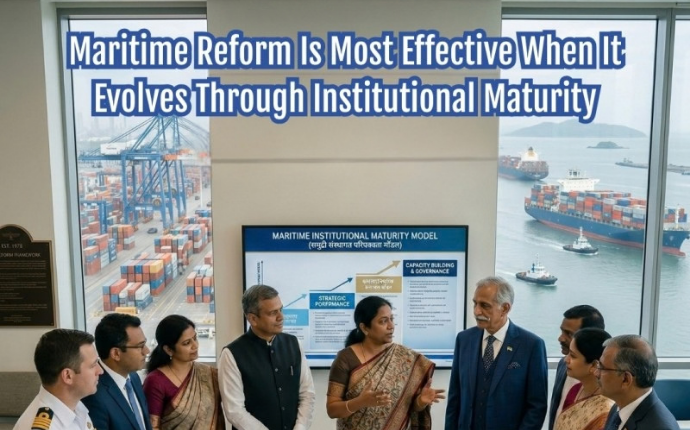
Where maritime governance achieves its most durable progress, reform tends to arise not from disruption alone, but from institutional maturity — the capacity of systems to observe their own evolution and realign deliberately before structural strain becomes visible. Reform, in this sense, is not an emergency response. It is an expression of developmental awareness.
Institutional maturity reflects the point at which governance begins to operate with reflective continuity. Structures no longer function merely as mechanisms for control or compliance. They become adaptive frameworks capable of recognising when accumulated change has altered the environment in which they operate. Reform then becomes a process of recalibration — the adjustment of institutional relationships so that governance remains proportionate to the scale and complexity of the system it supports.
Maritime activity provides a particularly clear setting in which to understand this distinction. The sector evolves through layered expansion. Trade networks grow denser. Technological systems become more sophisticated. Workforce mobility expands across jurisdictions. Financial and regulatory obligations multiply in response to global standards. Each stage of growth adds new dimensions to the system. None of these changes occurs in isolation, and none immediately invalidates existing governance structures. Instead, they gradually alter the context in which those structures function.
Over time, institutional frameworks built to manage earlier conditions may continue to operate effectively, yet require increasing effort to maintain alignment with present realities. Administrative processes become more complex as interaction multiplies. Regulatory boundaries intersect more frequently. Financial and operational systems influence one another in ways not originally anticipated. Governance remains functional, but its internal relationships begin to reflect accumulated layers of adaptation rather than integrated design.
Reform grounded in institutional maturity recognises this gradual transformation. It does not interpret complexity as failure. It interprets complexity as evidence of growth that now requires structural coherence. The objective is not to replace functioning institutions, but to reorganise their interaction so that governance continues to operate with clarity as the system expands.
This form of reform is developmental rather than corrective. It acknowledges that institutions evolve through historical layering. Each regulatory provision, administrative mechanism or financial safeguard is introduced to address a specific need. Over time, these elements accumulate. Institutional maturity lies in recognising when accumulated solutions must be restructured so that the system functions as a coherent whole rather than as an assemblage of responses to past conditions.
India’s maritime sector increasingly operates within precisely such a phase of institutional development. Expansion of maritime trade, global deployment of seafarers, integration into international regulatory frameworks and growth in domestic shipping capacity have collectively transformed the scale and scope of maritime governance. Institutions that have supported this growth have done so successfully. Yet success itself alters the environment in which governance functions.
Training systems must accommodate evolving technical competencies. Certification frameworks must remain intelligible across expanding global interaction. Financial assurance mechanisms must correspond to diverse forms of enterprise participation. Administrative processes must manage growing volumes of institutional engagement. Each component remains necessary. The challenge lies in ensuring that their interaction reflects the structure of contemporary maritime activity rather than the historical sequence through which they emerged.
Institutional maturity enables this transition from accumulation to integration. It introduces the capacity to examine how governance functions as a system rather than as a series of independent mechanisms. Reform becomes a process of aligning institutional relationships so that each component reinforces the others in proportion to present conditions.
Globally, maritime systems that demonstrate long-term resilience often exhibit precisely this pattern of evolutionary reform. Governance does not remain static. Yet neither does it oscillate through cycles of disruption and correction. Instead, institutions adjust through structured reflection. Policy development incorporates feedback from operational experience. Administrative structures are refined to reflect changing interaction patterns. Regulatory frameworks are updated to maintain coherence across expanding complexity.
Such reform is rarely dramatic. It may not generate immediate visibility because it does not arise from crisis. Yet its effects are profound. Systems that evolve through institutional maturity maintain continuity while adapting. Participants experience stability not because governance remains unchanged, but because change occurs through predictable and proportionate adjustment.
Predictability is central to the value of maturity-driven reform. Maritime systems depend on long-term planning. Investments extend across decades. Professional development spans entire careers. Infrastructure shapes economic geography for generations. Reform that emerges through structured institutional evolution allows these long-term commitments to remain viable because governance adapts without disrupting continuity.
By contrast, reform driven solely by reactive correction may achieve rapid adjustment but can introduce uncertainty if participants cannot anticipate how governance will evolve. Institutional maturity reduces this uncertainty by embedding change within coherent processes. Reform becomes part of the system’s developmental rhythm rather than an interruption to it.
Another defining characteristic of maturity-driven reform is inclusiveness of institutional perspective. Because such reform arises from reflection on system-wide evolution, it considers the interaction of multiple domains simultaneously. Regulatory, financial, operational and welfare frameworks are examined in relation to one another rather than in isolation. The objective is not improvement within a single domain, but coherence across the entire governance architecture.
India’s maritime environment increasingly benefits from precisely such integrative perspective. Dialogue across institutions, industry participants and workforce stakeholders reflects recognition that reform must support the functioning of the system as a whole. Institutional maturity manifests not only in structural adjustment, but in the quality of engagement through which adjustment is conceived and implemented.
The Indian Maritime Federation’s engagement across governance, industry and workforce environments reflects this orientation toward systemic coherence. Observations drawn from diverse segments of the maritime landscape indicate that reform is most effective when it reflects shared understanding of how institutional relationships are evolving. Alignment emerges through structured dialogue rather than unilateral adjustment.
Institutional maturity also shapes the pace of reform. Because evolutionary adjustment aims to preserve continuity, change unfolds with deliberate calibration. The objective is not speed for its own sake, but stability through alignment. Reform proceeds at a pace that allows institutional relationships to adapt without fragmentation.
This measured pace is often misunderstood as reluctance. In reality, it reflects recognition that maritime systems operate within dense networks of interdependence. Rapid structural change may produce unintended consequences if institutional relationships are not fully considered. Maturity-driven reform emphasises coherence over immediacy.
As maritime activity continues to expand in scale and complexity, the capacity to reform through institutional maturity becomes an increasingly significant strategic asset. Systems that can realign deliberately maintain operational stability while integrating new realities. They avoid cycles of strain followed by abrupt correction. Development proceeds with continuity rather than interruption.
India’s maritime future will continue to be shaped by technological transformation, environmental responsibility, evolving global trade patterns and expanding workforce mobility. Each of these developments will alter the conditions within which governance operates. Institutional maturity will determine how effectively governance adapts to these changes while preserving structural coherence.
Reform, in this context, is not a sign that institutions are failing. It is a sign that institutions are aware — aware of their own evolution, aware of the environment in which they function and aware of the need to remain proportionate to the system they sustain. Such awareness is itself a hallmark of maturity.
Maritime systems have always evolved alongside the conditions that shape them. Ships grow larger. Trade routes shift. Technology advances. Labour markets globalise. Governance evolves in parallel. When reform arises from institutional maturity, this evolution occurs with balance. Systems change, yet remain recognisable. They adapt, yet remain stable.
In the long trajectory of maritime development, the most enduring governance frameworks have been those capable of such adaptive continuity. They do not wait for disruption to compel change. They recognise change as an ongoing condition and align themselves accordingly.
Maritime reform, when grounded in institutional maturity, therefore represents not an interruption to stability but its preservation. It ensures that governance remains aligned with reality not only today, but as that reality continues to evolve. It transforms reform from a reactive measure into a continuous expression of institutional growth.
As India’s maritime system continues to mature, reform will remain an essential feature of its evolution. When undertaken through structured awareness and deliberate alignment, reform becomes one of the most powerful mechanisms through which long-term maritime strength is sustained.