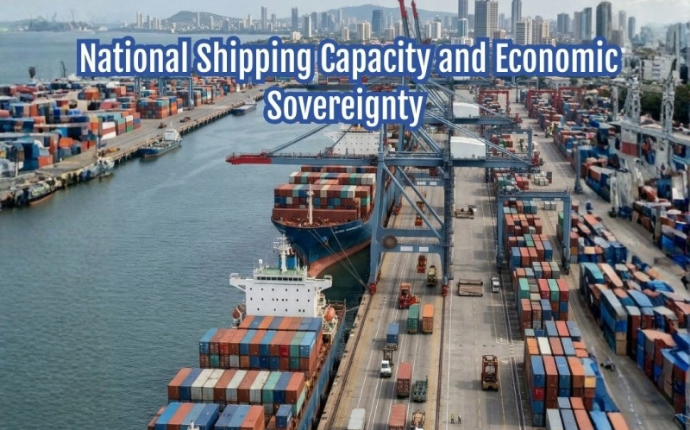
The movement of goods across oceans is often described as the circulation system of the global economy. Maritime transport connects production to consumption, resources to markets and domestic industry to international demand. For most nations, participation in this circulation is indispensable. Trade depends on reliable shipping, and economic growth often reflects the extent to which goods move efficiently across maritime routes. Yet beneath this functional necessity lies a deeper structural relationship between shipping and economic sovereignty.
Economic sovereignty refers to a nation’s capacity to sustain its development trajectory with sufficient control over the mechanisms that enable trade, supply and exchange. It does not imply isolation from global systems. Modern economies are interdependent by design. Rather, sovereignty concerns the degree to which participation in global exchange remains supported by domestic capability rather than wholly dependent on external provision. Within maritime economies, national shipping capacity becomes one of the most significant expressions of this capability.
Shipping is not merely a service that facilitates trade. It is a strategic function that determines how consistently a nation can maintain access to global markets, secure essential supply chains and respond to shifts in economic or geopolitical conditions. Where national shipping capacity is substantial and well integrated into domestic economic planning, trade flows remain supported by institutional mechanisms that the nation itself can influence. Where such capacity is limited, participation in maritime exchange may remain dependent on external structures whose priorities may not always align with domestic needs.
The relationship between shipping and sovereignty emerges most clearly when viewed across extended time horizons. Trade cycles fluctuate. Market conditions shift. Global logistics networks reconfigure in response to technological and geopolitical developments. Nations with robust shipping capacity retain the ability to adapt to these changes through mechanisms they help shape. Nations without such capacity may remain more exposed to external adjustments over which they have limited influence.
India’s economic trajectory increasingly underscores the significance of this relationship. As trade volumes expand and supply chains become more complex, the reliability of maritime transport assumes growing importance. Ensuring that national economic activity remains supported by stable shipping access requires institutional capacity that extends beyond participation in international shipping networks. It requires the development of shipping capability that is structurally embedded within the national economic framework.
National shipping capacity encompasses more than the number of vessels operating under a domestic flag. It reflects the broader ecosystem that supports maritime transport, including financial structures, regulatory frameworks, workforce capability and institutional governance. Capacity becomes strategically meaningful when these elements function together to sustain continuity of maritime operations across changing conditions.
This integrated perspective distinguishes shipping capacity from simple operational scale. A nation may participate extensively in maritime trade without developing the institutional depth that allows shipping to function as a stabilising economic mechanism. Economic sovereignty emerges where participation is accompanied by structured capability — where shipping operates not only as a commercial service but as a component of national economic resilience.
Globally, maritime economies that maintain strong domestic shipping capability often exhibit greater flexibility in managing trade disruptions or logistical realignments. Their shipping sectors provide continuity even when global market conditions fluctuate. Their infrastructure and regulatory frameworks support sustained operational readiness. Their workforce systems maintain professional capacity across generations. These features together allow maritime transport to function as a reliable extension of economic policy.
India’s maritime development increasingly reflects movement toward this form of integrated capability. Expansion of domestic shipping activity, investment in maritime infrastructure and alignment with international regulatory frameworks contribute to the strengthening of national shipping as a structural economic resource. The scale and diversity of India’s trade relationships further reinforce the strategic importance of maintaining stable maritime transport mechanisms.
National shipping capacity also influences how value is distributed within the broader maritime economy. Shipping generates not only transport services but associated financial, technical and professional activity. Fleet operations require maintenance, management, training and regulatory oversight. Each of these functions contributes to domestic economic participation. Strengthening national shipping therefore supports not only trade continuity but broader maritime sector development.
The Indian Maritime Federation’s engagement across policy dialogue and industry participation reflects recognition that shipping capacity functions as a systemic economic asset. Observations across the maritime landscape indicate that economic resilience strengthens where shipping capability is supported by coherent governance, accessible financial structures and sustained workforce development. Institutional alignment enhances the strategic value of operational capacity.
The international dimension of maritime trade further underscores the importance of domestic capability. Shipping networks operate across complex geopolitical and economic environments. Nations with well-developed shipping sectors maintain greater capacity to navigate these environments while preserving continuity of supply and trade. Domestic capability provides strategic flexibility that complements participation in global logistics systems.
Economic sovereignty within maritime contexts does not require self-sufficiency in all aspects of shipping. Global integration remains essential to modern trade. What it requires is the presence of institutional mechanisms through which a nation can sustain its maritime engagement with stability and agency. National shipping capacity provides precisely such mechanisms.
Workforce development forms a central component of this capacity. Skilled maritime professionals sustain the operational and managerial functions that allow shipping to function reliably. Training institutions, certification systems and professional pathways contribute to the continuity of expertise that supports domestic shipping capability. Human capital, when integrated into the broader shipping ecosystem, reinforces the structural basis of economic sovereignty.
Financial architecture also plays a decisive role. Shipping is capital-intensive, and the ability to finance fleet development, maintenance and operational continuity shapes the extent to which national shipping capacity can expand and modernise. Financial frameworks that support sustained investment while maintaining stability contribute directly to the resilience of maritime transport as an economic function.
Administrative and regulatory coherence further determine how effectively shipping capacity translates into economic sovereignty. Governance systems must provide clarity, predictability and coordination across the various domains that maritime activity intersects. Where institutional frameworks operate with consistency, shipping capacity functions not merely as infrastructure but as a dependable instrument of economic continuity.
The temporal dimension of maritime development reinforces why national shipping capacity functions as a strategic economic asset. Ships operate for decades. Infrastructure remains in place for generations. Institutional frameworks evolve gradually. The accumulation of capability across time produces structural resilience that cannot be created quickly in response to sudden disruption. Economic sovereignty emerges from sustained investment and continuous institutional development.
Maritime history offers numerous examples of how nations have relied on domestic shipping capacity to maintain economic stability during periods of global uncertainty. Systems that possessed structured maritime capability were able to adapt trade patterns, sustain supply chains and preserve economic continuity. Those that relied exclusively on external shipping often faced greater vulnerability to disruption.
India’s continued economic growth and integration into global markets make the development of national shipping capacity an increasingly significant component of long-term economic planning. As trade networks expand and logistical systems evolve, maintaining stable maritime transport mechanisms becomes central to preserving economic momentum.
National shipping capacity, when supported by coherent institutional frameworks, functions as a stabilising force within the broader economy. It ensures that the movement of goods remains aligned with domestic priorities while remaining integrated into global exchange. It provides the structural means through which economic engagement with the world can occur with continuity and resilience.
In the architecture of modern maritime economies, shipping is more than a commercial activity. It is an enabling condition for sustained participation in global trade. When this enabling function is supported by domestic capability, economic sovereignty acquires practical form. It becomes embedded within the structures that sustain exchange rather than dependent solely on external provision.
As India continues to strengthen its maritime presence, the development of national shipping capacity will remain closely linked to the preservation of economic sovereignty. Ships, infrastructure and institutional systems together form the mechanisms through which trade flows remain stable across time. In the long trajectory of economic development, these mechanisms provide not only connectivity to global markets but the structural assurance that such connectivity can be sustained on terms that support national resilience.