Risk has always been an intrinsic feature of maritime activity. Long before the emergence of modern shipping networks, the movement of goods across water involved exposure to forces beyond direct control. Weather, distance, mechanical uncertainty and the complexity of navigation created conditions in which outcomes could not be guaranteed. Over time, maritime systems did not eliminate this uncertainty. Instead, they developed mechanisms to organise it.
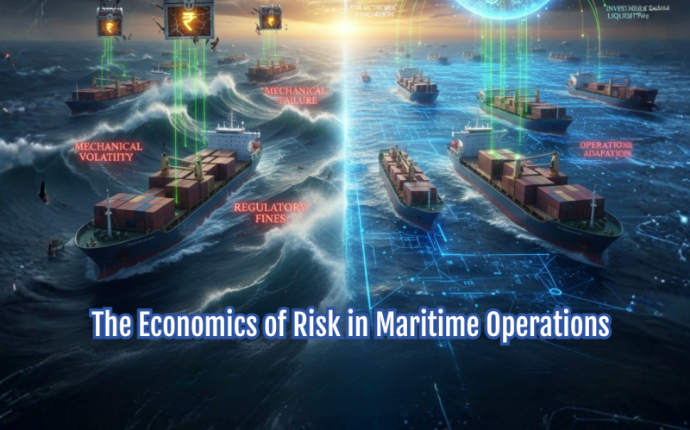
Modern maritime economies are defined not by the absence of risk, but by the sophistication with which risk is distributed across institutions, enterprises and financial structures. The stability of maritime activity depends on how exposure is allocated, absorbed and managed across the system as a whole. Where risk distribution is coherent, maritime economies demonstrate resilience across fluctuating conditions. Where distribution remains fragmented or disproportionate, vulnerability becomes embedded within the structure of participation itself.
Risk distribution models therefore form one of the foundational architectures of contemporary maritime systems. They determine how operational uncertainty translates into financial responsibility, how compliance obligations are sustained across complex environments and how individual disruptions are prevented from becoming systemic instability. In essence, they define how maritime economies transform inherent uncertainty into organised continuity.
The evolution of maritime risk distribution reflects the progressive expansion of maritime activity itself. Early forms of risk sharing often relied on collective financial participation in individual voyages. Modern shipping, by contrast, operates through intricate networks of contractual obligations, insurance frameworks, compliance assurance mechanisms and regulatory oversight. Each layer reflects the growing complexity of maritime systems and the increasing need to distribute exposure across multiple institutional domains.
This complexity arises from the multidimensional character of contemporary maritime operations. Risk no longer pertains solely to the physical movement of vessels. It encompasses environmental responsibility, labour protection, financial solvency, technological reliability and regulatory compliance across jurisdictions. Each dimension introduces specific forms of exposure that must be managed simultaneously.
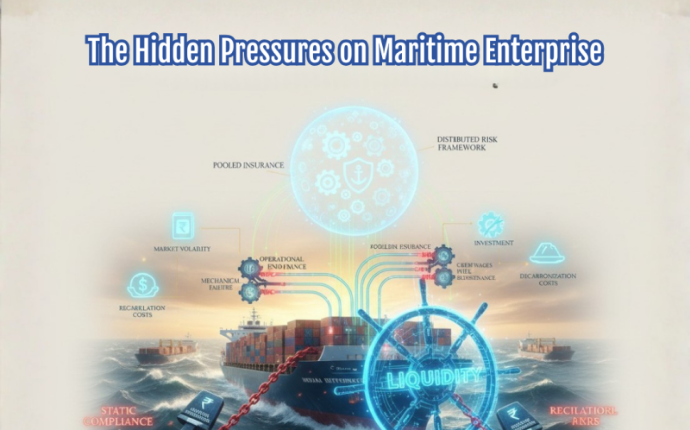
Effective risk distribution models recognise that no single participant can absorb this full spectrum of exposure without compromising operational viability. Enterprises require mechanisms that allocate responsibility proportionately while preserving the capacity to function productively. Institutions require assurance that obligations will be met even when individual actors encounter disruption. Financial systems require structures that maintain liquidity while safeguarding accountability. Risk distribution becomes the mechanism through which these requirements are reconciled.
India’s maritime sector increasingly operates within such complex risk environments. The expansion of domestic shipping capacity, the global deployment of Indian seafarers and the integration of maritime activity into broader economic systems have multiplied the forms of exposure that must be managed. Ensuring that risk remains distributed in ways that support both resilience and participation is therefore a central element of sectoral development.
Distribution does not imply dilution of responsibility. Rather, it reflects structured allocation of responsibility across mechanisms designed to sustain continuity. Insurance systems, financial guarantees, regulatory oversight and institutional safeguards all contribute to this allocation. Each mechanism addresses specific dimensions of risk while functioning within an integrated framework that supports overall system stability.
The effectiveness of such frameworks depends on proportionality. Risk must be distributed in ways that correspond to operational scale, institutional capacity and economic context. Where allocation becomes disproportionate, either by concentrating exposure excessively or by fragmenting responsibility without coherence, the system may remain formally compliant while becoming structurally fragile. Balanced distribution ensures that accountability remains credible without constraining the capacity for sustained participation.
Globally, maritime economies that demonstrate strong resilience typically operate through well-developed risk distribution architectures. Insurance frameworks pool exposure across broad participation. Compliance mechanisms align with operational realities. Financial assurance systems protect against specific contingencies while preserving liquidity within enterprises. Governance structures provide oversight that reinforces rather than replaces distributed responsibility.
These arrangements allow maritime activity to function across environments where uncertainty is permanent. Participants operate with the knowledge that exposure is organised rather than isolated. Individual disruption is absorbed through mechanisms designed precisely for that purpose. Systemic continuity becomes possible because risk has been structured in advance.
India’s maritime ecosystem continues to evolve within this broader global pattern. As participation expands across operational and economic domains, the design of risk distribution mechanisms assumes increasing strategic importance. The challenge lies not in eliminating exposure, which remains inherent to maritime activity, but in ensuring that exposure is organised in ways that support long-term stability.
The Indian Maritime Federation’s engagement with industry participants and institutional frameworks reflects the centrality of this structural perspective. Observations across the maritime landscape indicate that systems remain most stable where risk allocation aligns with both operational realities and institutional capacity. Dialogue that supports coherence in financial assurance, compliance structures and governance mechanisms contributes directly to strengthening risk distribution frameworks.
Risk distribution also influences the inclusiveness of maritime development. Systems that allocate exposure proportionately allow diverse forms of participation to coexist within a stable framework. Enterprises of varying scale can engage productively when financial and regulatory obligations reflect structured allocation rather than uniform imposition. Inclusiveness becomes compatible with stability when risk is organised across the system rather than concentrated within individual participants.
Technological transformation further underscores the importance of adaptable risk distribution models. Advances in digital navigation, environmental compliance and operational automation introduce new forms of exposure that must be integrated into existing frameworks. Systems capable of incorporating emerging risk dimensions without disrupting overall coherence demonstrate higher levels of institutional maturity.
International maritime engagement adds an additional layer of complexity. Risk distribution must function across jurisdictions where regulatory expectations and financial mechanisms differ. Recognition of insurance arrangements, enforcement of compliance standards and coordination of financial responsibility all require structures capable of operating across institutional boundaries. Coherent risk distribution enhances a nation’s capacity to participate effectively within such transnational environments.
India’s expanding role in global maritime activity increasingly depends on the credibility of its risk distribution frameworks. International partners evaluate not only operational capability but the reliability of mechanisms that allocate financial and regulatory responsibility. Systems that demonstrate clarity, proportionality and continuity in risk distribution integrate more seamlessly into global maritime networks.
The temporal dimension of maritime investment further reinforces the importance of structural risk allocation. Ships operate across decades. Workforce participation spans extended careers. Infrastructure shapes economic activity for generations. Risk distribution models must therefore function across long time horizons, preserving continuity through cycles of expansion, technological change and economic fluctuation.
Maritime history illustrates that systems capable of sustaining long-term development have consistently organised risk in ways that prevent volatility from destabilising participation. Financial and institutional mechanisms evolve alongside operational complexity, ensuring that exposure remains manageable even as scale increases. Distribution, rather than concentration, becomes the defining principle of resilience.
India’s maritime future will continue to involve expansion, integration and transformation. Each of these processes introduces new forms of exposure that require structured allocation. Ensuring that risk distribution models evolve in alignment with these developments will be essential to sustaining the stability of the sector.
Risk, in maritime activity, cannot be removed. It can only be structured. Distribution transforms uncertainty into organised responsibility. It allows systems to function across environments where variability is constant. It preserves continuity not by eliminating disruption, but by ensuring that disruption remains contained within frameworks designed to absorb it.
In the architecture of modern maritime economies, risk distribution models therefore perform a foundational role. They sustain operational viability, support financial stability and enable diverse participation across expanding systems of maritime activity. Through structured allocation of exposure, they convert inherent uncertainty into manageable structure — and in doing so, they form one of the essential pillars of long-term maritime resilience.