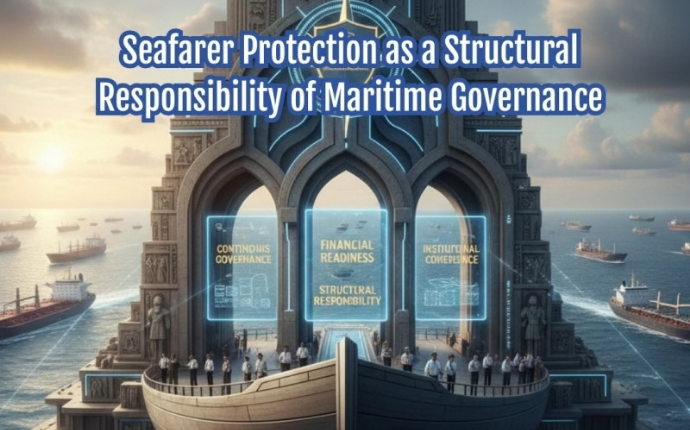
Seafarer Protection as a Structural Responsibility of Maritime Governance
Maritime governance has always been shaped by the realities of distance. Ships operate far from the institutions that regulate them. Crews work in environments where immediate access to administrative support is rarely available. Employment relationships extend across jurisdictions, while responsibility must remain continuous despite the movement of vessels across national boundaries. Within such a system, the question of protection is not peripheral. It is structural.
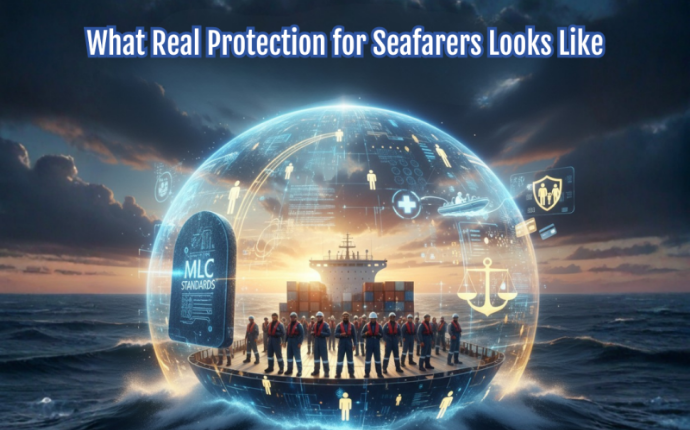
Seafarers do not merely participate in maritime activity. They sustain it. Every operational framework, every regulatory standard and every commercial arrangement ultimately depends on the presence of individuals who live and work within conditions that few other professions encounter. Their environment is defined by isolation, exposure to physical risk, extended separation from social support and continuous interaction with systems that must function reliably across long distances. Protection within such a context cannot be episodic. It must be built into the architecture of governance itself.
Historically, maritime regulation emerged first to ensure the safety of navigation and the integrity of vessels. Over time, recognition grew that operational safety alone was insufficient if the individuals responsible for maintaining that safety lacked structured protection of their own. Labour standards, welfare provisions and international conventions gradually established that seafarer protection is not an adjunct to maritime governance but one of its defining responsibilities.
This recognition reflects a fundamental institutional principle. Systems that rely on human participation under conditions of heightened exposure must ensure that protection travels with the individual rather than remaining tied to geographic or administrative location. Maritime employment, by its nature, challenges traditional frameworks of labour protection because it unfolds across environments where institutional proximity is variable. Governance must therefore function through mechanisms capable of operating continuously regardless of where the individual is situated.
India’s maritime workforce represents one of the most globally distributed professional communities in the country. Indian seafarers serve across international fleets, operating under diverse administrative regimes while remaining connected to national institutional frameworks of certification, welfare and regulatory oversight. Their protection depends on the interaction between domestic governance structures and global maritime systems. This interaction must function with coherence if protection is to remain consistent across varied operational contexts.
The scale of India’s seafaring presence further emphasises the structural nature of protection. When a workforce is widely distributed across international waters, welfare cannot depend solely on reactive intervention. Response must be supported by systems designed to anticipate need, mobilise resources without delay and maintain continuity of support across jurisdictional transitions. Protection becomes less a matter of individual case management and more a matter of institutional capacity embedded within governance frameworks.
International maritime conventions have long recognised this requirement. Standards governing employment conditions, health care, repatriation and financial security reflect the understanding that seafarers operate within environments where vulnerability is not exceptional but inherent. Protection must therefore be systemic rather than discretionary. It must be anchored in mechanisms that function as reliably as the operational systems they support.
The relationship between protection and governance extends beyond welfare outcomes. It influences the stability of maritime systems themselves. A workforce that operates with confidence in the reliability of institutional support sustains operational continuity under demanding conditions. Confidence reduces uncertainty not only for individuals but for enterprises and regulators who depend on predictable labour environments. Protection, in this sense, supports both human wellbeing and system resilience simultaneously.
As maritime sectors expand and diversify, the conditions under which seafarers operate continue to evolve. Technological change alters onboard environments. Commercial pressures influence deployment patterns. Global labour mobility introduces new forms of contractual complexity. Each of these developments shapes the context within which protection must function. Governance frameworks must adapt accordingly, ensuring that mechanisms of support remain aligned with changing operational realities.
India’s maritime ecosystem has developed extensive institutional structures dedicated to certification, welfare administration and regulatory oversight of seafarer employment. These structures reflect sustained commitment to ensuring that participation in global maritime activity is accompanied by reliable institutional backing. As the sector grows, the capacity of these structures to operate cohesively across expanding exposure becomes an increasingly central consideration.
Protection as a structural responsibility requires more than formal provision of rights. It requires operational readiness to deliver support under conditions that may be logistically and administratively complex. Financial mechanisms must be capable of mobilising resources without delay. Administrative pathways must remain clear even when jurisdictional boundaries are crossed. Institutional coordination must function across multiple actors who share responsibility for different aspects of welfare. Each of these elements contributes to the continuity of protection.
Globally, maritime governance systems that have achieved durable stability often display strong integration between welfare frameworks and broader regulatory architecture. Protection is not treated as a separate domain but as an intrinsic component of operational oversight. Financial assurance, labour regulation and compliance mechanisms interact in ways that ensure support remains accessible whenever required. The system functions as a whole rather than as a collection of parallel responsibilities.
India’s maritime community increasingly recognises the importance of such integration. As workforce scale increases and operational environments become more interconnected, the effectiveness of protection depends on how seamlessly institutional components function together. Ensuring this coherence requires continuous attention to how welfare mechanisms, financial structures and regulatory processes interact across the system.
The Indian Maritime Federation observes these interactions through its engagement across multiple segments of the maritime ecosystem. Experience indicates that seafarer protection remains most effective when it is embedded within governance structures that operate with clarity, coordination and financial readiness. Supporting dialogue around these structural dimensions therefore contributes to the long-term stability of maritime labour systems.
Protection, when understood structurally, becomes more than response to vulnerability. It becomes an institutional capability that sustains confidence across the workforce. It allows individuals to engage in maritime employment with assurance that support will remain present regardless of operational circumstance. It allows enterprises to rely on stable labour environments. It allows regulators to maintain oversight with the knowledge that welfare mechanisms function continuously.
Maritime governance has always balanced multiple responsibilities—ensuring safe navigation, sustaining commercial continuity and protecting those who make maritime activity possible. Among these responsibilities, the protection of seafarers occupies a distinctive position. It is both an ethical obligation and a structural necessity. Without reliable protection, the human foundation of maritime systems becomes uncertain. With reliable protection, participation remains stable even under demanding conditions.
As India’s maritime sector continues to deepen its global engagement, the structural integration of seafarer protection will remain central to its institutional evolution. Governance that embeds protection within its core architecture ensures that welfare is not dependent on circumstance but sustained by design. In a system defined by movement across vast and often unpredictable environments, such design becomes one of the most enduring sources of stability.
Maritime activity depends on ships that remain seaworthy and routes that remain navigable. It depends equally on individuals who remain supported wherever they operate. When protection functions as a structural responsibility rather than a reactive provision, maritime governance fulfils one of its most fundamental purposes—to ensure that those who sustain the system are sustained by it in return.