Every maritime voyage carries within it a balance that is rarely visible from shore. On the surface, shipping appears as movement—cargo transported, routes navigated, schedules maintained. Beneath that movement, however, lies a constant process of risk evaluation and absorption. The sea has never offered certainty. Weather patterns shift, mechanical systems face stress, markets fluctuate, and human endurance is tested across long distances and extended periods of separation. Maritime operations therefore exist within an environment where uncertainty is not an interruption but a permanent condition. The economic structure of the sector has always evolved in response to this reality.
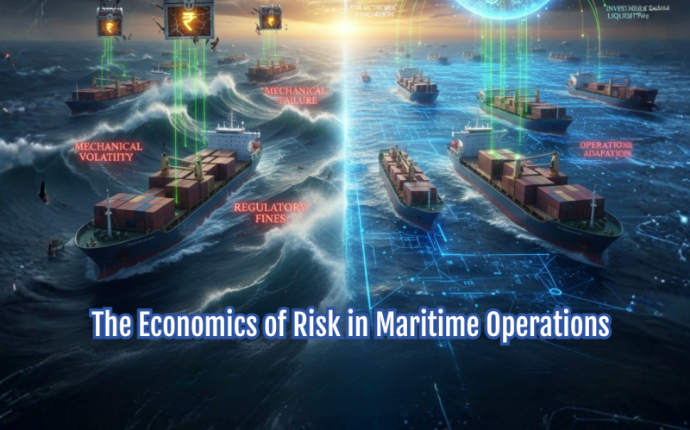
Risk in maritime activity is not a singular phenomenon. It operates across multiple layers simultaneously. There is physical risk, associated with navigation, machinery and environmental exposure. There is commercial risk, shaped by global trade cycles, freight rates and contractual obligations. There is financial risk, arising from capital investment, operational costs and regulatory requirements. There is human risk, reflected in the vulnerability of individuals whose work unfolds far from direct institutional support. Each layer interacts with the others. A mechanical failure can generate financial loss. Market volatility can affect operational planning. Human welfare concerns can trigger administrative response that influences commercial continuity. Maritime risk, therefore, is not compartmentalised. It is systemic.
Historically, maritime institutions have developed mechanisms to manage these risks through structures that emphasise responsibility and resilience. Vessel classification systems ensure technical standards are maintained. Insurance arrangements distribute financial exposure across broader pools. Regulatory frameworks establish operational expectations that reduce the likelihood of adverse events. Training systems prepare personnel to function effectively under demanding conditions. Each of these mechanisms represents an attempt to stabilise an inherently unstable environment. They do not eliminate risk. They shape how risk is carried.
In economic terms, the central question is not whether risk exists but how it is allocated. Allocation determines who bears uncertainty, when it is absorbed and how its impact is distributed across the system. When risk is concentrated, the consequences of disruption fall heavily on specific actors, potentially limiting their capacity to continue operations. When risk is distributed, its impact becomes more manageable, allowing the system as a whole to remain stable even when individual events occur. The structure of risk allocation therefore influences not only financial outcomes but the continuity of maritime activity itself.
Within India’s maritime ecosystem, the allocation of risk has historically been expressed through a combination of regulatory safeguards, financial instruments and institutional oversight. These mechanisms reflect a commitment to ensuring accountability while preserving operational integrity. Financial guarantees, for example, serve to demonstrate responsibility and provide assurance that obligations will be met if required. Insurance arrangements offer protection against specific categories of loss. Regulatory compliance reduces exposure to preventable hazards. Together, these structures create a framework within which risk is acknowledged and managed rather than ignored.
As maritime activity expands in scale and complexity, however, the economic characteristics of risk begin to change. Growth introduces greater interdependence among system components. Financial commitments increase as operations become more sophisticated. Workforce mobility extends across wider geographical areas. Administrative coordination involves more actors and more processes. Each of these developments alters how risk is experienced and how its consequences propagate through the system. What once affected individual operations may now influence broader networks of activity. The economic weight of risk becomes more diffuse yet more interconnected.
This transformation invites reconsideration of how risk management structures function under conditions of scale. Mechanisms that operate effectively within moderate levels of activity may encounter increasing strain when exposure multiplies. Financial instruments designed to secure responsibility may tie up capital that could otherwise support operational adaptation. Administrative processes intended to verify accountability may extend the time required to mobilise response when circumstances demand immediacy. None of these outcomes reflects structural weakness. They reflect the changing economic environment within which risk is being managed.
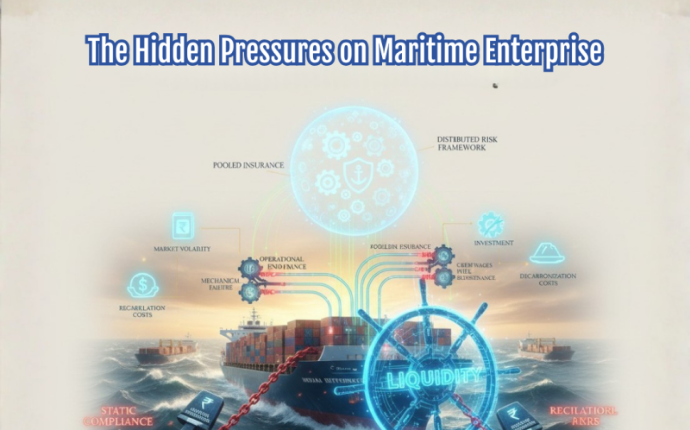
The relationship between risk and capital is particularly significant in maritime operations because the sector is inherently capital-intensive. Vessels represent substantial investment. Compliance requirements often involve financial commitments that must be maintained continuously. Operational continuity depends on liquidity that allows enterprises to respond to fluctuating market conditions. When capital is allocated primarily toward static forms of assurance, its capacity to absorb dynamic uncertainty may become constrained. The balance between securing responsibility and maintaining flexibility therefore becomes an economic consideration as much as a regulatory one.
Globally, maritime systems that have reached advanced stages of development have gradually shifted their emphasis toward risk-sharing structures that distribute exposure across broader institutional frameworks. Rather than concentrating responsibility within individual entities, they create mechanisms through which risk is pooled, evaluated collectively and managed through coordinated financial and administrative arrangements. Such structures recognise that when risk is systemic, its management must also be systemic. Stability emerges not from isolating exposure but from distributing it in ways that preserve operational continuity across the sector.
India’s maritime sector is increasingly positioned within this evolving economic landscape. The scale of its workforce, the reach of its commercial engagement and the complexity of its regulatory environment all contribute to a setting in which risk is experienced as an interconnected phenomenon rather than a series of isolated contingencies. Managing this interconnected risk requires approaches that recognise how financial, operational and human factors interact. It requires structures that allow responsibility to be demonstrated without limiting the system’s ability to respond dynamically to change.
The economics of maritime risk therefore extends beyond calculation of potential loss. It encompasses the design of institutional arrangements that determine how resilience is maintained across varying conditions. Where risk is carried by individual actors alone, resilience depends on their capacity to absorb disruption independently. Where risk is distributed through structured mechanisms, resilience becomes a characteristic of the system itself. The difference lies not in the magnitude of risk but in how its consequences are mediated.
For maritime professionals and enterprises, the practical experience of risk is often shaped by how these economic structures operate in real time. Decisions regarding investment, staffing and operational deployment are influenced by expectations about how uncertainty will be managed when it arises. Predictable risk allocation supports confident planning. Uncertain or concentrated exposure encourages caution and conservatism. Over time, these behavioural responses influence the pace and pattern of sectoral growth.
Within India’s maritime community, awareness of these dynamics has been gradually deepening as activity continues to expand. Dialogue increasingly reflects recognition that managing risk effectively requires not only maintaining strong safeguards but also ensuring that the economic structures through which those safeguards operate remain proportionate to the scale of exposure. The objective is not to reduce responsibility but to organise it in ways that sustain stability across an increasingly complex operational environment.
The Indian Maritime Federation engages with these questions through its ongoing observation of how risk management mechanisms interact with financial and operational realities across the sector. Experience suggests that the strength of maritime resilience depends not solely on the presence of safeguards but on how those safeguards distribute and absorb uncertainty. Supporting system-wide stability involves contributing to conversations that examine how risk can be structured in ways that preserve accountability while enhancing flexibility.
As India’s maritime presence continues to deepen its integration into global networks, the economic character of risk will remain a defining feature of sectoral development. The capacity to manage uncertainty effectively will influence investment decisions, workforce confidence and institutional credibility. Maritime operations will always involve exposure to forces that cannot be fully predicted or controlled. The question that shapes long-term stability is how those forces are absorbed when they arise.
In the long history of maritime enterprise, the sea has never been made less uncertain. What has changed over time is how institutions have learned to carry that uncertainty collectively. The economics of risk, in its most mature form, reflects not the elimination of exposure but the creation of structures that allow complex systems to remain stable despite it. As India’s maritime sector continues to grow in scale and significance, the evolution of such structures will quietly determine how confidently it navigates the uncertainties that have always defined life at sea.